


CCB vs. Lawsuit for Copyright Infringement
Compare the Copyright Claims Board with federal copyright litigation so you can decide which path may fit your dispute, evidence, damages, and business goals.
1.
CCB vs. Federal Copyright Lawsuit
↓
2.
When the CCB May Make Sense
↓
3.
When Federal Court May Be Better
↓
4.
Cost, Discovery, and Damages
↓
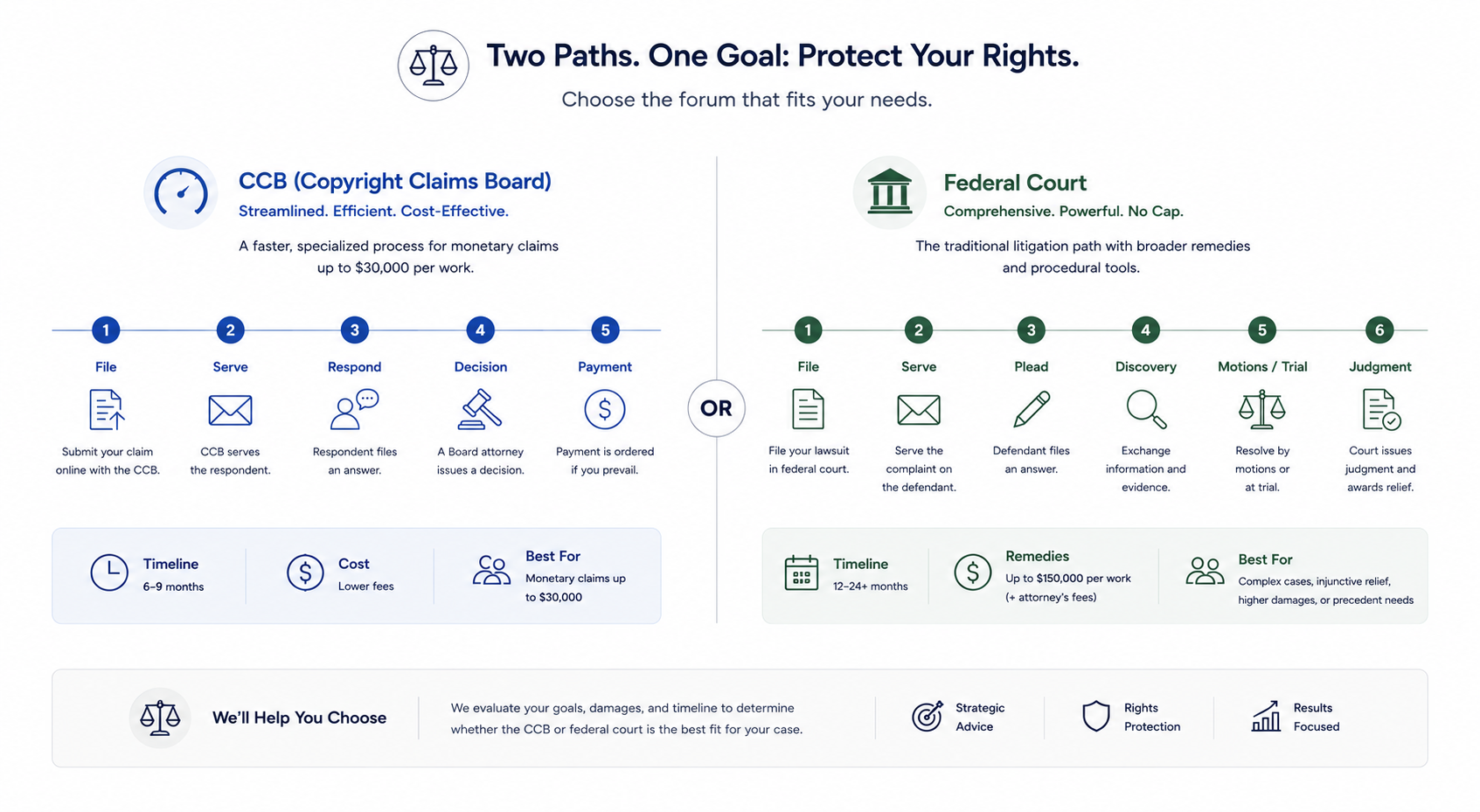
1. CCB vs. Federal Copyright Lawsuit
The Copyright Claims Board and a lawsuit for copyright infringement are two different paths for resolving copyright disputes. The CCB is a tribunal within the U.S. Copyright Office designed for certain lower-value copyright claims. A federal copyright lawsuit is filed in federal court and may provide broader litigation tools.
Neither path is automatically better. The right forum depends on the value of the dispute, the strength of the evidence, the need for discovery, the available damages, the urgency of the issue, and the client’s broader business goals.
2. When the CCB May Make Sense
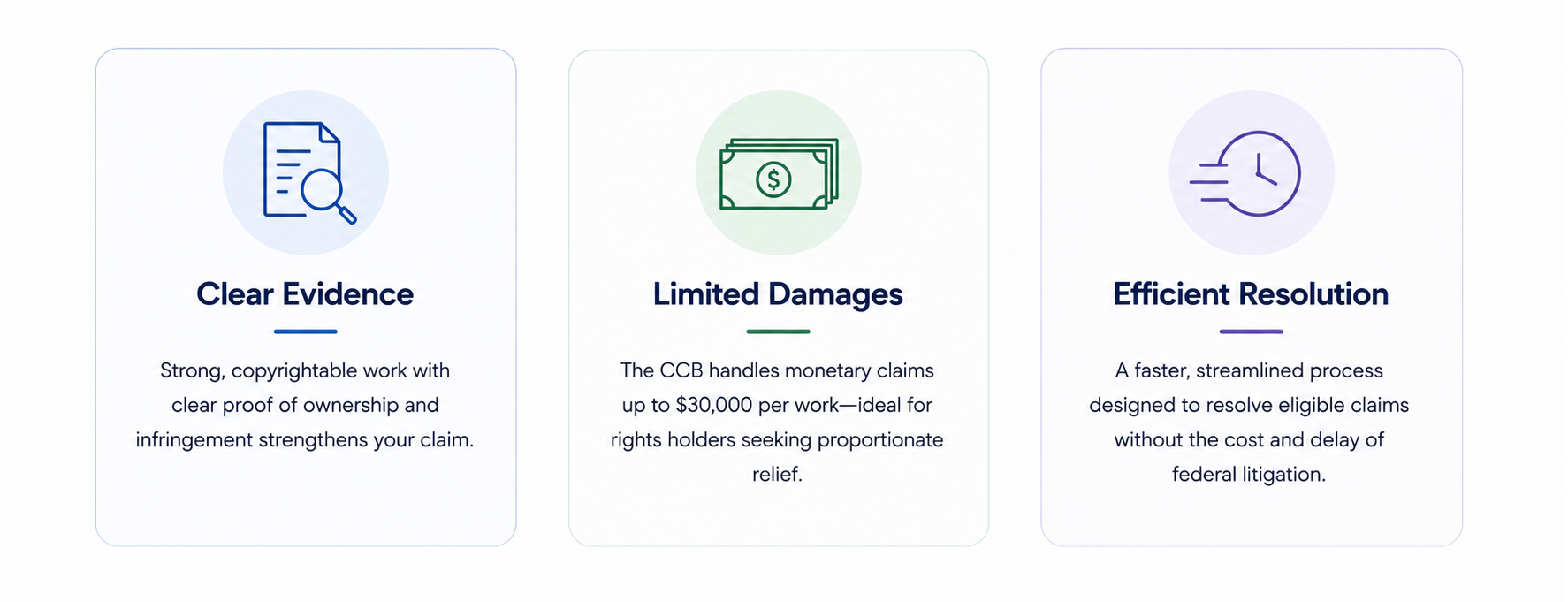
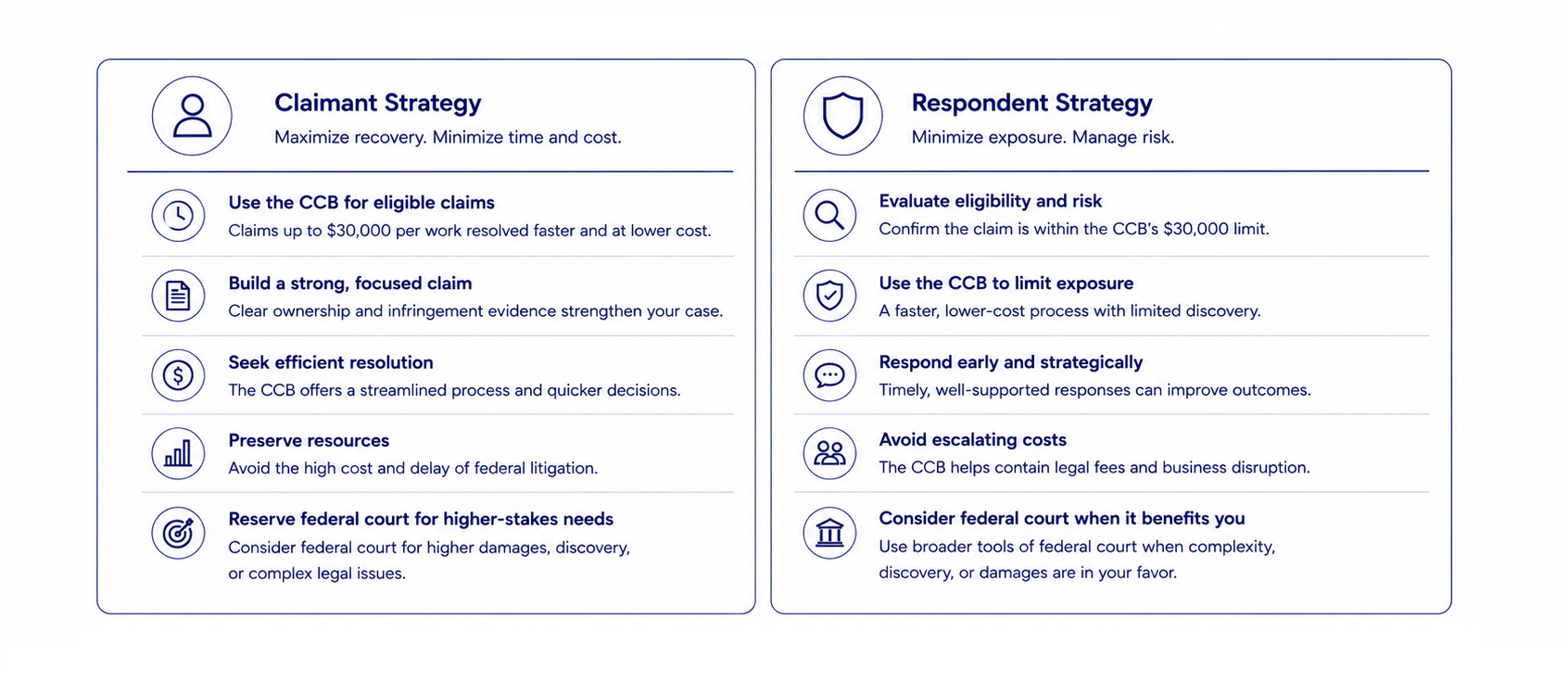
The CCB may make sense when the dispute is real, the damages are meaningful but limited, and the parties would benefit from a more focused process than federal court. It may be especially useful when the core facts are straightforward and the evidence can be presented clearly.
Common examples may include copied photographs, reused website content, unlicensed product images, stolen written materials, copied packaging artwork, unauthorized videos, or creative assets used in advertising or online listings.
A CCB claim may also create formal pressure without immediately requiring the full cost and complexity of federal litigation. However, the claim should still be prepared carefully. A streamlined forum does not eliminate the need for strong evidence, ownership analysis, and a realistic damages theory.
3. When Federal Court May Be Better
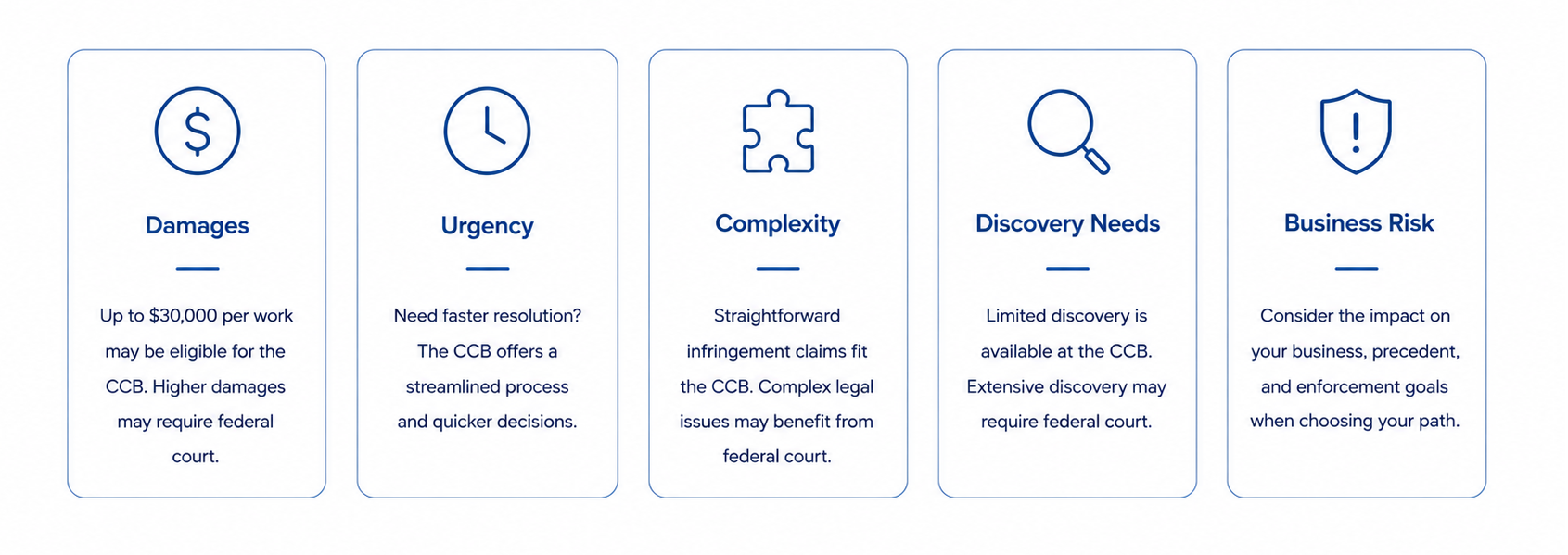
Federal court may be the better forum when the dispute is high value, legally complex, urgent, or strategically important. Federal litigation may offer broader discovery, more formal procedures, stronger court tools, and potentially higher damages in appropriate cases.
A lawsuit for copyright infringement may be more appropriate if the alleged infringement caused significant harm, the defendant profited substantially, multiple parties are involved, ownership is disputed, evidence is difficult to obtain, or the client needs relief that the CCB cannot fully provide.
Federal court may also be preferred when the respondent is likely to opt out of the CCB or when the claimant wants to preserve stronger procedural options from the beginning.
4. Cost, Discovery, and Damages
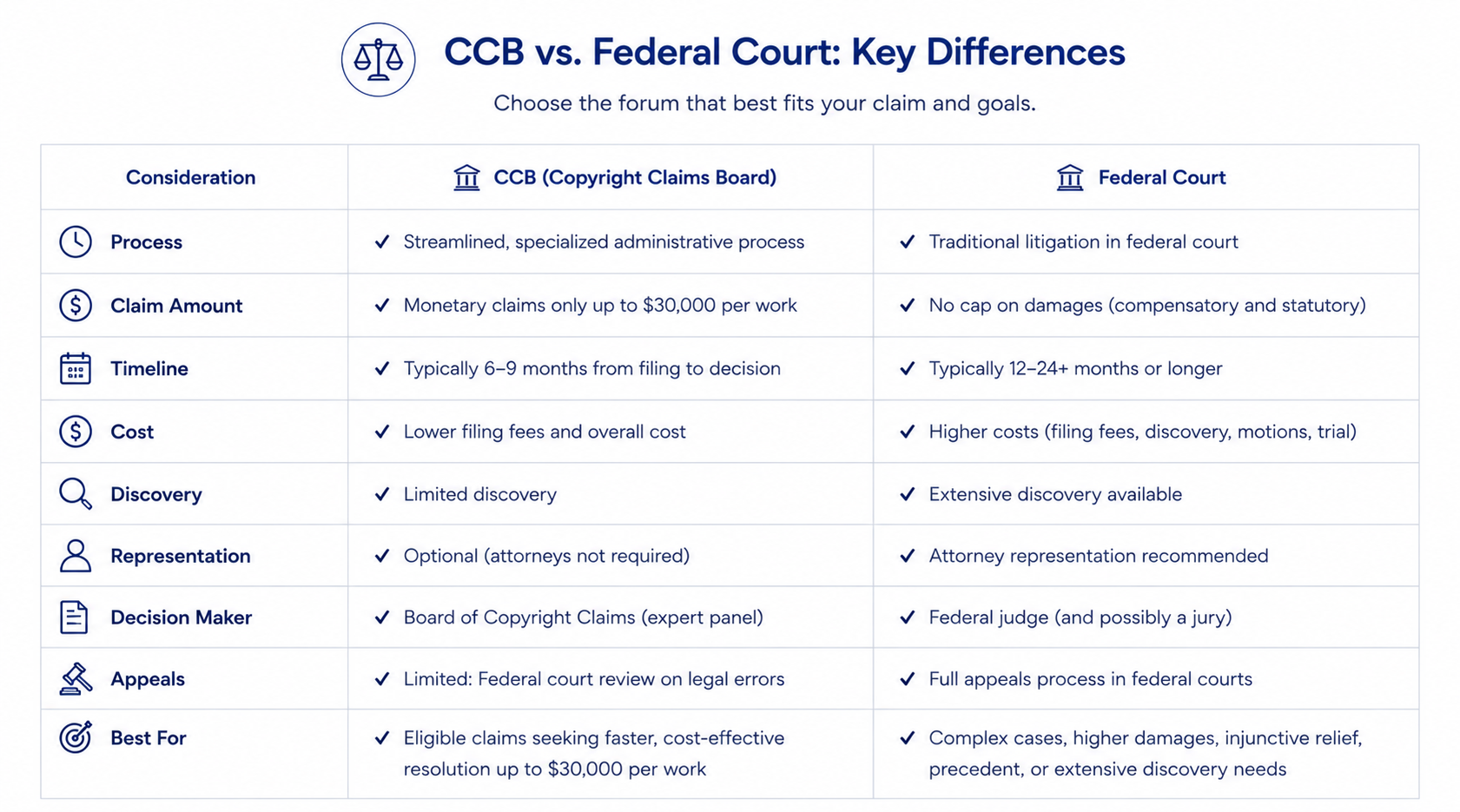
The biggest practical differences between the CCB and federal court often involve cost, procedure, discovery, and damages. The CCB is designed to be more contained. Federal court is more formal and may allow broader litigation tools.
In the CCB, discovery is generally more limited, the process is designed to move more efficiently, and monetary recovery is capped. In federal court, discovery may be broader, motion practice may be more extensive, and damages may be higher depending on registration timing, statutory damages, actual damages, profits, and the facts of the dispute.
These differences can shape settlement leverage. A lower-cost forum may help resolve smaller disputes efficiently, while federal court may create stronger leverage when the claim is larger, more complex, or requires more procedural tools.
5. Opt-Out Strategy and Risk
The opt-out feature is one of the most important strategic differences between the CCB and federal court. In many CCB matters, a respondent may have a limited window to opt out. If the respondent opts out, the CCB proceeding may end, but the dispute itself may not be over.
For claimants, this means filing in the CCB should include a realistic assessment of whether the respondent is likely to participate. If the respondent opts out, the claimant may need to consider settlement, a demand strategy, DMCA tools, or a lawsuit for copyright infringement in federal court.
For respondents, the opt-out decision should not be automatic. Participating may provide a more contained way to resolve the dispute. Opting out may be appropriate when the claim is weak, damages are overstated, federal court protections are preferred, or broader strategic issues are involved.
6. How Cohn Legal Can Help
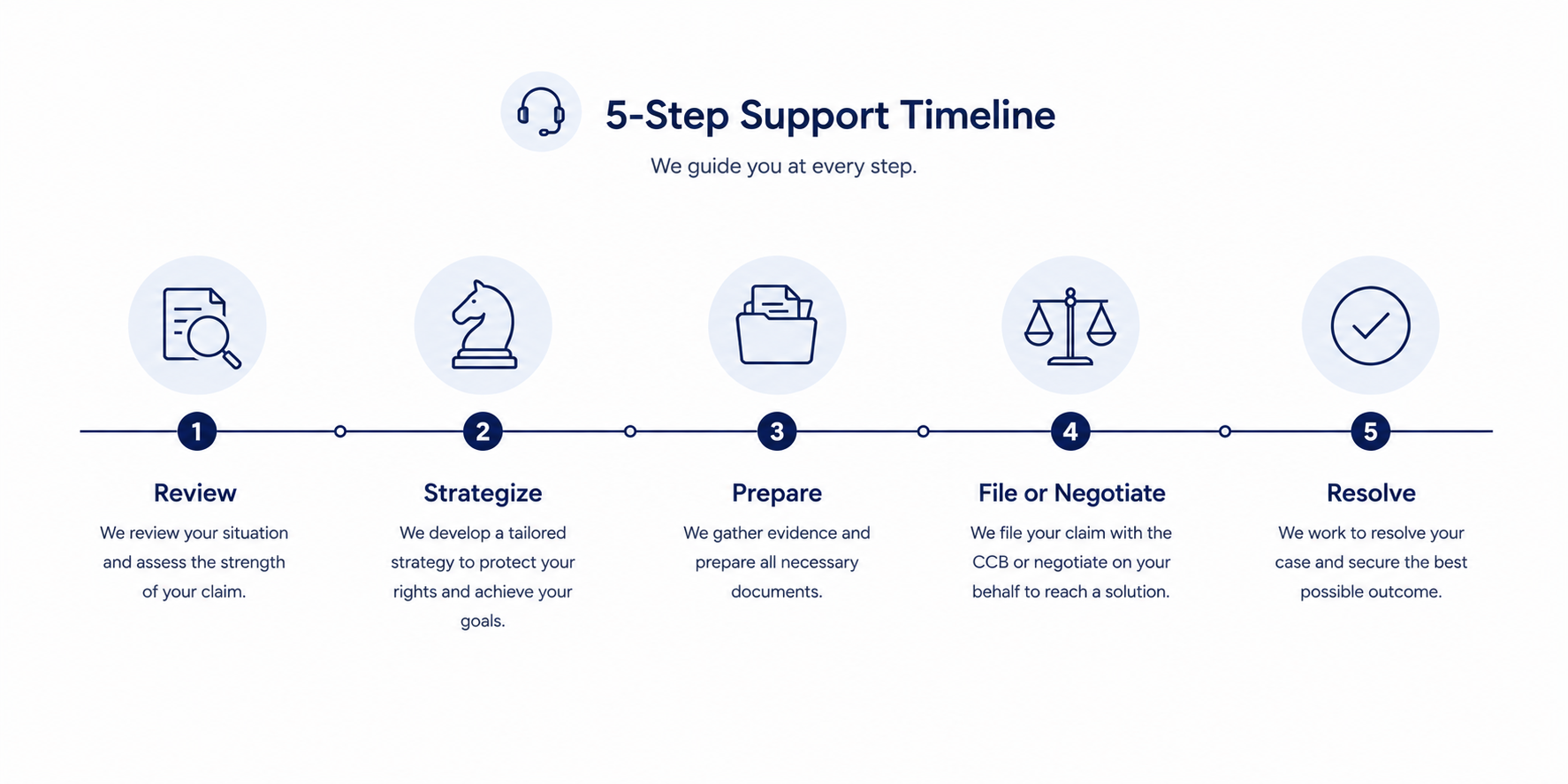
Choosing between the Copyright Claims Board and a lawsuit for copyright infringement should be a strategic decision. Cohn Legal, PLLC can help evaluate the facts, evidence, damages, deadlines, defenses, business risk, and likely forum options before a claim is filed or a response is made.
For copyright owners, that may mean determining whether the CCB is strong enough to create leverage or whether federal court, DMCA action, settlement outreach, or another enforcement strategy makes more sense. For respondents, it may mean deciding whether to participate, negotiate, opt out, or prepare for litigation.
The goal is not to force every matter into the same process. The goal is to choose the path that protects the client’s work, reduces risk, and creates the strongest practical outcome.
CCB vs. Copyright Lawsuit Questions
Is the Copyright Claims Board the same as filing a federal lawsuit?
No. The CCB is a tribunal within the U.S. Copyright Office. A federal copyright lawsuit is filed in federal court and usually involves more formal procedures.
Is the CCB always better for smaller copyright claims?
No. The CCB may be useful for certain smaller claims, but the right forum depends on the facts, evidence, damages, defenses, and respondent strategy.
When should a copyright owner consider federal court instead?
Federal court may be better when damages are substantial, discovery is needed, urgent relief is required, or the dispute involves complex ownership or business issues.
Can a respondent opt out of a CCB claim?
In many cases, respondents have a limited window to opt out. That decision should be made carefully because the dispute may continue outside the CCB.
Does federal court allow more discovery than the CCB?
Generally, federal court provides broader discovery tools, while the CCB is designed to use more limited procedures.
Should I speak with a copyright lawyer before choosing a forum?
Yes. Forum choice can affect leverage, cost, damages, deadlines, and the overall strategy of the copyright dispute.
Choose the Right Copyright Forum Before You Act
The Copyright Claims Board may be a strong option for certain copyright disputes, but it is not always the best forum. A lawsuit for copyright infringement may be necessary when the claim is larger, more complex, or requires stronger court tools.
Cohn Legal, PLLC can help you compare the CCB with federal court and choose a strategy based on the evidence, damages, risk, and business realities of your dispute.