Understanding Trademarks


Have you ever wondered why the Prada can sell a pair of shoes for $1500.00?  Are the shoes really worth such an obscene amount of money?  Well, the reality is that these shoes are “worth” what people are willing to pay for them and the mere presence of the Prada name, or Trademark, on the shoe makes it worthy of a $1500.00 price tag.  Trademarks are signatures and transmit a message of reputation when attached to a good or product. A trademark tells the consumer something about the product without the consumer having to actually know anything about the product.  Is this a good quality shoe? Well, it has the Gucci name on it so  it must be a high-end product. The trademark may be a word, symbol, phrase, or graphic design and if branded properly, distinguishes the given product from those of the company’s competitors.

When To Apply for a Trademark in the USPTO


Protect Your Brand at All Costs.

Ultimately, companies are built with the objective of selling them (or at least the potential to sell them).  More than anything else, the essence of a company – the thing that is most valuable, is its intellectual property.  The company name, logo and branding assets that consumers recognize and relate to when deciding to purchase a company’s products or services.  If you are serious about the future of your business, you must protect your branding assets with trademarks. 

Can Anything be Trademarked?

Trademarks Must be Sufficiently Distinct

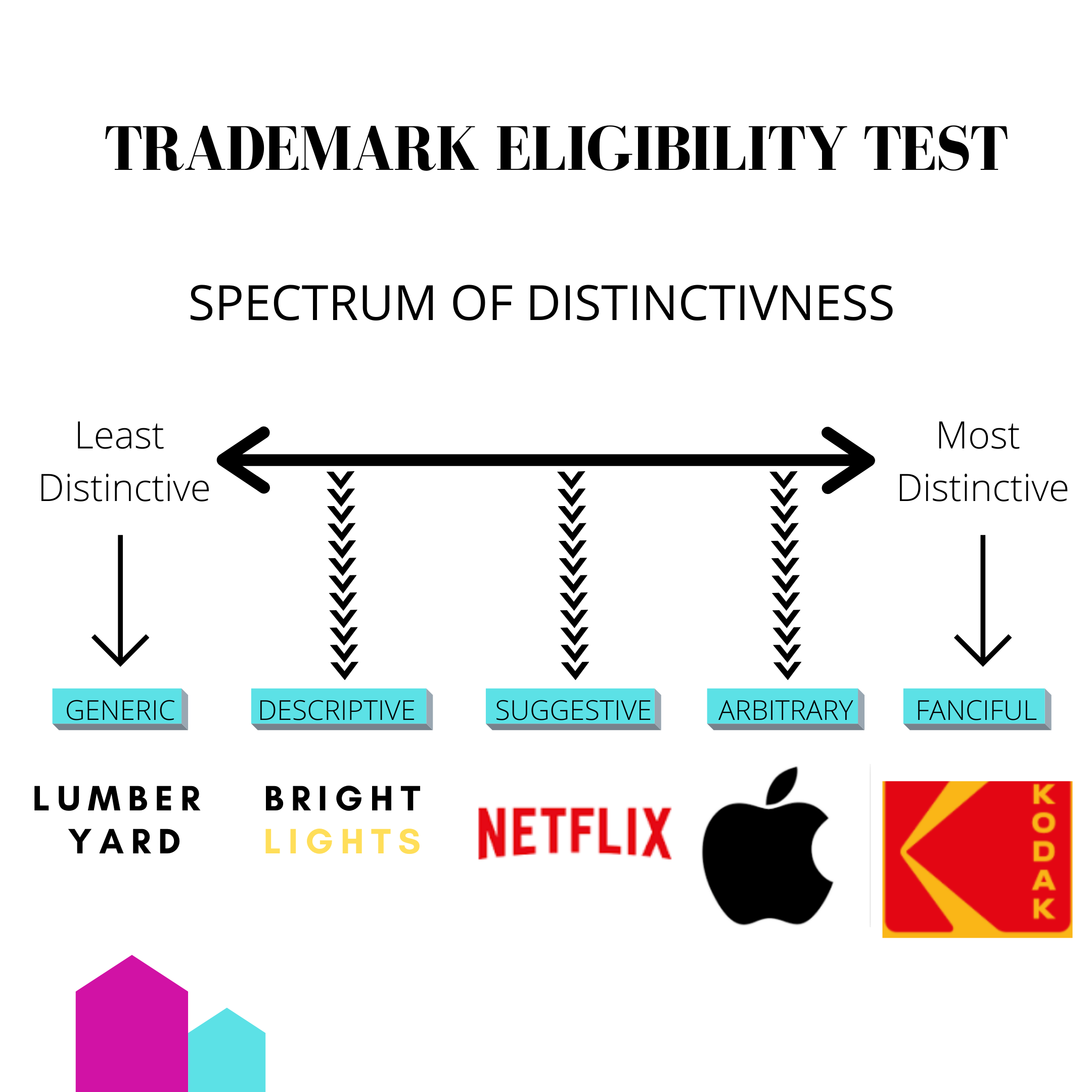
Names/Logos are eligible for obtaining trademark rights according to their uniqueness – the more distinct the mark, the more trademarkable and the less distinct, the less trademarkable.  Consider for the moment a Carpet company that wants to call itself, “Rugs.”  Clearly, there is nothing distinct about this choice of brand name and instead, we (along with the USPTO) would likely classify this name as one that is “Generic” and therefore undeserving of trademark protection.  When you’re starting out, please try to come up with a new and novel name that will make your company stand out.


Trademarks must be used “in commerce”

Remember, a trademark is a source identifier – it may be word, logo, slogan, and/or design that when attached to a good or service, enables a consumer to identify the company which produces the good/service. If you are not actually selling anything under your clever name or design, you do not actually have a trademark – you just have a clever name or design.  To obtain trademark protection in the United States Patent and Trademark Office (USPTO), you must have made a significant number of sales of your product/service in Interstate-Commerce.


Trademark Use and Potential Conflicts With Other Businesses

Trademark rights generally arise through qualifying use of a mark to identify the source of goods or services. There is no universal minimum number of sales that establishes trademark use, and sales in two states are not an automatic requirement.

For a federal application based on Section 1(a), goods generally must be sold or transported in qualifying commerce, with the mark properly displayed on the goods, packaging, or an acceptable associated display. For services, the mark must be used or displayed in the sale or advertising of services that are actually rendered in qualifying commerce. Activities within one state may qualify depending on the circumstances.

If qualifying use has not begun, an applicant with a bona fide intention to use the mark may apply under Section 1(b). Under that basis, qualifying use must be established before registration.

Before adopting or applying for a mark, evaluate potentially conflicting rights. Another business’s use of a similar name does not automatically prevent your use or registration, but different products, industries, or trademark classes do not automatically eliminate a conflict.

The analysis considers the similarity of the marks, the relationship between the goods or services, priority, and the scope of existing rights. Review federal registrations, pending applications, and unregistered marketplace uses rather than assuming that a different product category makes the name available.


 

trademark eligibility test

What can’t you trademark


When does the USPTO deny applications?

Applications are routinely rejected based on the “likelihood of confusion” standard. According to the USPTO, “likelihood of confusion exists between trademarks when the marks are so similar and the goods and/or services for which they are used are so related that consumers would mistakenly believe they come from the same source. Each application is decided on its own facts, and no strict mechanical test exists for determining the likelihood of confusion.” As you can see, there is no bright-line rule to follow. That’s why utilizing a top trademark lawyer experienced with the USPTO makes sense.


How long does it take?

There is no guaranteed timeline for federal trademark registration. The time to the first examining action and the overall application process depend on USPTO workloads, the filing basis, any refusals or requirements, opposition activity, and outstanding use requirements.

Consult the USPTO’s current trademark processing statistics when estimating timing. Filing establishes an application date, but it does not guarantee registration or a particular completion date.