Trademark Lawyer New York: Our Trademark Attorneys Provide New York City Business With Trademark Filings and Brand Protection
Cohn Legal, PLLC is located in Midtown-Manhattan and specializes in trademark law. Our New York trademark practice is robust and comprehensive, providing the following trademark services: trademark search, trademark application, trademark registration, trademark renewal, trademark oppositions, trademark office action responses, and a variety of other legal services integral to the practice of trademark law.
What Our Customers Say
★★★★★
Abe was absolutely fantastic to work with. He provided exceptional guidance throughout the entire trademark filing process and was incredibly diligent, ensuring our application was filed successfully. His expertise and commitment made a potentially complex process smooth and stress-free. We highly recommend Cohn Legal to anyone needing top-tier trademark support!
D
Dimitris Manos
✔
Google
★★★★★
They help me with my trademark for my business. It took a while but they were always keeping me informed and always available whenever I have questions. Mr. Cohn is incredible and always responded in a timely manner whether via email or phone call. Great place, I mostly work with Shantel-Lee and she was great.
T
Tanesher Bennet
✔
Google
★★★★★
Abe was extremely helpful with the trademarking process. Communication was clear, and the process was handled efficiently and professionally. I would recommend Cohn Legal to anyone looking for trademark services.
D
David Shaulian
✔
Google
★★★★★
I can’t say enough how thrilled I am with Cohn Legal. I was awarded my trademark, the cost was very reasonable, and the process was straight forward. I highly recommend this incredible firm and I am grateful for their work!
J
Jim Manico
✔
Google
★★★★★
Very smooth process of acquiring a trademark – they were on top of everything every step of the way. It’s a long process so appreciated them keeping track of things and making it a painless process for us.
Trademark Attorney Services for New York City Businesses
Trademarks are critically important because they represent and indeed protect a company’s most important asset; it’s identity.
Why are NYC customers willing to spend $5000 on a Gucci purse instead of $200 on a Guess purse that looks, for all intensive purposes, nearly identical? Because people feel a certain way when they walk around Manhattan with the Gucci name on their bag. This feeling, which is imbued by the Trademark, is the essence of trademark law and it is incumbent on all brand leaders to understand the importance of brand identity to the company’s broader success.
Our trademark lawyers are often asked with only a tiny bit of cheeky mischief, “Are you the best trademark attorneys in New York?” Naturally, we are expected to say yes (and humbly, yes indeed we are!) but this question actually runs much deeper than the coy client suspects. More precisely, what does it actually mean to be a top new yorktrademark lawyer? Does it mean possessing the greatest understanding of trademark law? Filing the largest number of trademarks in the United States Patent and Trademark Office (USPTO)? Recognizing a client’s potential trademark infringement of a competing mark and developing a strategy to overcome this barrier?
On a technical level, an excellent New York trademark attorney will adeptly navigate through questions of trademark eligibility, the applicability of the Polaroid-consumer confusion test (don’t steal other people’s names!) and drafting compelling responses to USPTO office actions after initial trademark applications have been rejected. However, perhaps most importantly, the best trademark attorney will have a sufficiently advanced understanding of trademark law to effectively design and protect the brand identity of the client’s company.
Your brand is everything; Guard it with your life.
How to Defend Your Trademark Against Infringement
Defending your trademark against infringement is crucial to protecting your brand and intellectual property. Trademark infringement occurs when another party uses a trademark that is identical or confusingly similar to yours without authorization, potentially harming your business’s reputation and confusing your customers.
Here are steps to take when defending your trademark:
Monitor Your Trademark: Regularly search the marketplace and databases for potential infringements. This includes online platforms, domain names, and product listings. Setting up alerts can also help you keep track of any unauthorized use of your trademark.
Cease-and-Desist Letter: The first step in defending your trademark is often sending a formal cease-and-desist letter to the infringing party. This letter notifies them of your trademark rights and demands that they stop using the mark immediately. It is often effective in resolving conflicts without legal action, as many infringers may not be aware of the violation.
Negotiation and Settlement: If the cease-and-desist letter doesn’t result in a resolution, negotiation or settlement may be the next step. You may be able to work out an agreement with the infringing party, such as licensing your trademark to them or settling the dispute with financial compensation.
Filing a Lawsuit: If informal methods fail, you may need to file a lawsuit. This is the most aggressive approach, but sometimes necessary to protect your rights. A trademark infringement lawsuit typically takes place in federal court. If successful, the court can issue an injunction to stop the infringing use and may award damages.
International Infringement: If your trademark is being infringed internationally, it is important to leverage international treaties such as the Madrid Protocol to enforce your rights in other countries. Working with an attorney experienced in international trademark law can help ensure that your mark is protected globally.
Trademark Cancellation: In some cases, you may need to challenge the validity of another party’s trademark registration. This can be done through a petition to cancel the registration, which is particularly useful if the other party’s trademark is confusingly similar to yours or was registered in bad faith.
Proactively defending your trademark through vigilance, legal action when necessary, and effective use of cease-and-desist letters can help safeguard your brand and prevent costly damages in the future.
Trademark Lawyers: Back to the Basics
What is a Trademark? Trademarks are what make you, you.
First and foremost, what is a trademark? A trademark is ultimately, a source identifier – when a consumer sees a given trademark on a good, it is immediately apparent to the consumer which company produced the good. A trademark may, therefore, be viewed as a company’s signature. The trademark may be a word, symbol, phrase, or graphic design and if branded properly, distinguishes the given product from those of the company’s competitors. Consider for the moment your internal experience of viewing a shoe with a Nike Swoosh on it. If you are a fan of Nike, seeing the Swoosh will immediately conjure up positive assumptions about the shoe; You will likely think that the shoe is of high quality, that it is expensive, that it is “cool”, that it is durable, and that it will be comfortable when you wear it. Is any of this true (short of it being expensive)? Well, it doesn’t really matter. What counts is that you believe all of these things to be true simply by virtue of the fact that it has the Nike Swoosh on it.
Trademark Attorney Registration: Filing Trademarks for NYC Based Businesses
Can Anything be Trademarked?
A common misconception is that any “trademark” (name, logo, design) is trademarkable. This is in fact not the case.
In order for a term to be suitable for trademark registration, it must clearly indicate the source company of the goods/services. Simply, the word or phrase must be able to distinguish a product or service from other similar products or services by allowing a consumer to understand the brand behind the word or phrase. If the word/phrase/logo does not do the work of communicating something about the brand which is selling the product, it is not successfully functioning as a trademark.
When a USPTO trademark examining attorney reviews a trademark application, he or she will ask “how will the average person perceive this mark?”. Will the average person be more or less likely to purchase the goods to which the mark is affixed because of the reputation of brand behind the trademark? Will the average person even pay attention to the “brand”? Is the “trademark” now indistinguishable from the product (Kleenex vs tissues etc.)? The answers to these questions are not always obvious but the framework is quite clear.
Ultimately, Marks are eligible for obtaining trademark rights according to their distinctiveness – the more distinct the mark, the more trademarkable and the less distinct, the less trademarkable. Indeed, the “strength” of the given mark (which is in large part a function of its distinctiveness) will both determine the likelihood of obtaining trademark protection in the USPTO and the probability of effectively stopping a future competitor from using the mark. So, what does it mean for a mark to be “distinct”?
Distinct Trademarks Are Strong Trademarks
A cornerstone feature of trademark law is the legal doctrine of the Spectrum of Distinctiveness (and yes, the Best Trademark Attorney in New York should know this). The Spectrum of Distinctiveness is a conceptual tool, which allows the USPTO to evaluate a trademark’s uniqueness and individuality. At one end of the spectrum are fanciful marks (think NIKE – an otherwise made up and distinct word) and at the other end are “Generic” trademarks ( A lumber company calling itself “the lumber company). Fanciful marks are the most powerful of trademarks and are readily admissible to the USPTO while generic trademarks are the weakest and are inadmissible. Immediately next to Fanciful trademarks on this spectrum of distinctiveness are Arbitrary marks which are trademarks that use common, but otherwise irrelevant names to identify brand assets. For example, a Computer company calling itself “Apple”, despite the fact that its computers have nothing to do with the fruit, Apple, is a classic illustration of an Arbitrary mark and is eligible for trademark protection.
In the middle are marks that are “Suggestive” which are also trademarkable. These marks do not explicitly describe the good/service being sold but rather merely suggest the nature and/or purpose of the goods (“Bronzetinge for suntan lotion). However, as we move along the spectrum, marks that are “Descriptive” and quite literally describe the nature of the goods sold (ex. The Sweet Honey Company) ARE NOT trademarkable.
One can see that the difference between Descriptive and Suggestive is subtle but the standard boils down to the ease with which the consumer can tie the mark to the good. If the consumer must use his imagination to intuit the nature of the goods based on the name of the trademark, the trademark is considered to be suggestive, rather than descriptive, and therefore eligible for trademark protection. Understanding the nuances of the Spectrum of Distinctiveness is truly a hallmark feature of new york’s best trademark attorneys.
Quick List of Terms/Phrases Which Cannot be Trademarked
Terms merely conveying information: Any term or phrase that simply provides information about the actual goods or services to be sold under the banner of the mark can’t be trademarked. Examples of terms that convey information are Sweet for candy, Long Lasting on dietary supplements, or Unlimited Data and Messaging for mobile phone services.
Widely used messages: This category includes political, religious, social, or popular slogans, messages, or mottos. The following phrases would very likely be rejected by a trademark examining attorney if someone sought to trademark them: Occupy Wall Street, I Love New Yor, Think Big, Made in the USA, In God We Trust, etc.
Religious quotes or passages: Wording quoted directly from the Bible, the Torah, the Quran, or any other religious text cannot be trademarked. These direct quotes are incapable of indicating the source of a good or service.
Federal Trademarks are only “Trademarks” Upon Use in Interstate Commerce
When you apply to register a trademark, the trademark must be “attached” to a specific good or service. Remember, if you are not selling anything or providing a bona fide service, your catchy name or slogan is not actually operating as a Trademark – it’s just a clever name or slogan. Thus, you cannot register a trademark without designating a specific product or service which is either already being sold in conjunction with the trademark or a product/service which you intend to sell in the future (more on this later). Moreover, selling the product/service in interstate commerce is not enough; you have to make a meaningful number of sales, rather than token sales, the customers across state lines. Thus, simply calling you sister across the country and selling her a single t-shirt would not satisfy the Use in Commerce requirement because not enough sales have been made.
Trademark Specimens
You might very well be wondering, How does the USPTO Know if I’m actually selling any products or services? Well, when filing the trademark application, the USPTO requires the Applicant to provide examples of how their trademark will be used in commerce as part of their trademark application. These trademark examples are known as trademark Specimens of use, or simply, Specimens. Of course, depending on the product or service sold, the Applicant will have different “types of Specimens” available to demonstrate Use in commerce. If you’re not yet using your trademark in commerce and are filing an Intent-to-Use application, then you do not need to submit a specimen upfront however ultimately, you will need to submit a Statement of Use to the USPTO along with a specimen to complete your Registration. Specimens are also required when you are submitting your trademark maintenance documents to the USPTO. One idiosyncratic scenario where a specimen isn’t required occurs when the U.S. trademark application is based on existing foreign registrations.
The USPTO has strict guidelines as to what it will and will not accept as a specimen for Goods. In general, the USPTO will accept the following:
Photographs of the mark displayed on the product itself or on the product packaging.
Product labels displaying the trademark. For example, the label on the inside of a shirt (conversely, simply writing the trademark on the shirt will not satisfy the specimen requirement).
A webpage showing the product, the trademark, and information on purchasing the product. Screenshots or hard copy printouts of the screen are acceptable as well.
Instruction booklets, assembly instructions, or any other printed materials that are included the goods.
The specimen requirements for Services are slightly different because by definition, services are not tangible and therefore must be advertised through different marketing vehicles. Acceptable specimens for services include but are not limited to the following:
Advertisements for the services
Marketing materials
Photographs of signage about the services
Webpages that describe the service, display the logo, and include purchasing info
Critically, the trademarks that appear on your specimens must match, exactly, the trademark as it used applied for in your trademark application.This sounds simple enough, but it is not uncommon for an application to apply for the “plain-text” version of the trademark, while in the real world, the trademark is used as a stylized-logo. If there is too big of an incongruency between the mark as it is applied for in the application and the mark as it appears on the specimen, the examining attorney may very well reject the trademark application.
Another important point to understand is that each Class in a given trademark application must have a distinct and separate specimen to accompany it. Remember, the USPTO has created a classification system for all the goods and services that can be included in a trademark application which allows for up to 45 distinct categories of goods/services. If you were to submit a trademark application for a certain class of goods and a similar trademark existed for an entirely different class of goods, then your trademark might still be approved because trademarks are protected vis-a-vis the particular good/service sold under the banner of the mark; Similar trademarks may be distinguishable from each other if they are in different classes. If you are selling T-shirts, Computers, and Paintings under the banner of your trademark, you will need three separate classes and 3 separate Specimens. However, if you were to sell multiple items which are all covered under the same class, you only need to submit 1 specimen. For example, if you list 20 different clothing articles in your trademark application, you still only have to submit one specimen because all 20 products belong to Class 025. However, if you have multiple products or services across multiple classes, then you need to submit multiple specimens.
Can I Trademark My Creative Work?
Well, it depends frankly on what you mean by “Creative”. Remember, trademarks are fundamentally source identifiers and are purely designed to allow a consumer to understand the source-producer of the good/service to which the trademark is affixed. Therefore, trademarks are inappropriate as protective mechanisms for commonly thought of “creative works”, like movie scripts, songs, lyrics, and paintings. Instead, these forms of intellectual property are protected by Copyright law.
What about Trademarks for the Titles of Creative works? Certainly, J. K Rowling should have the right to trademark “Harry Potter”?! Fundamentally, there is a unique challenge when it comes to trademarking the titles of creative works such as films, books, DVDs, CDs, and other media and the United States Patent and Trademark Office (USPTO) will very often often reject trademark applications for creative works because they consider the desired trademark to be merely the “title of a single creative work.”
A single creative work is one in which the creative content remains static and unchanged; No sequels, future editions, enhancements, or updated versions are planned. For such countless books, films, CDs, and recorded songs, the titles of these “single creative works” are ineligible for trademark protection.
Why Can’t Titles of Single Creative Works Be Trademarked?
The reason that titles of single creative works can’t be trademarked is because the title of a creative work does not indicate the source. Remember, the main purpose of a trademark is to identify the source of the underlying product. Would a single book title tell the reader anything about the source-producer of the book? Not really. Single title’s tend to be stand alone items and do not reach the threshold of creating a brand association, in the same way for example that “Lord of The Rings….” tells a reader that they are about to read a book by Tolkein, in a different sort of way then the mere title, “The Fellowship of the Ring”.
Therefore, the creator or author of a creative work needs to show evidence that the title they wish to trademark is part of a series. For example, labeling a book or film as Part 1, Volume I, or First Edition, indicates that there are additional works under that title to come. If the creator can show evidence that they are intent on producing a series of creative works under the same title, then it can be considered for trademark approval.
Can I Publish a Creative Work Without a Trademark?
You can publish a book or any other creative work without trademark protection and of course it’s extremely common. However, you do want to make sure that you protect your intellectual property in some way before proceeding with publication. Consider the scenario; Imagine that you woke up tomorrow morning and someone else has applied for your exact same trademark with the USPTO before you got a chance to register your trademark. Would you be upset by this development? Would it harm your business? If this answer is no, then there’s no reason to rush into applying for a federal trademark. However, if the answer is yes, it is time to get started with the US Federal Trademark Application process. Contact one of our trademark attorneys who can give you advice on how to protect your title of a single creative work.
Must I Complete My Series of Creative Works Before Submitting a Trademark Application?
No, it’s not necessary to have completed your series of creative works before submitting a trademark application to the USPTO.
You may identify the creative works you wish to be branded with your desired trademark by filing an “intent-to-use” application with the USPTO. Then, when you have sufficient evidence that you are creating a series of work, you will be required to provide that evidence to the USPTO. Typically, producing at least one additional work in your series is evidence enough for a trademark examining attorney to that your creative work requires trademark protection. However, the author or creator must be sure that the content of the work changes significantly with each new version that’s produced.
Do Trademarks Last Forever?
Well, that’s up to you. Once you go through the process of registering your trademark with the United States Patent and Trademark Office (USPTO), a trademark can last forever, as long as it continues to be used in commerce.
Thus, trademarks are not designed to expire (unlike patents and copyrights) according to any set number of years but instead, they will last as long as you or your business continues to sell your products or services using the registered trademark. Remember, the purpose of a trademark is to serve as a source identifier; as long as the trademark continues to serve as a source identifier, consumers will continue to associate the the products attached to the mark with the brand identity of the trademark holder and therefore, the trademark may very well be immortal.
What is Trademark Maintenance?
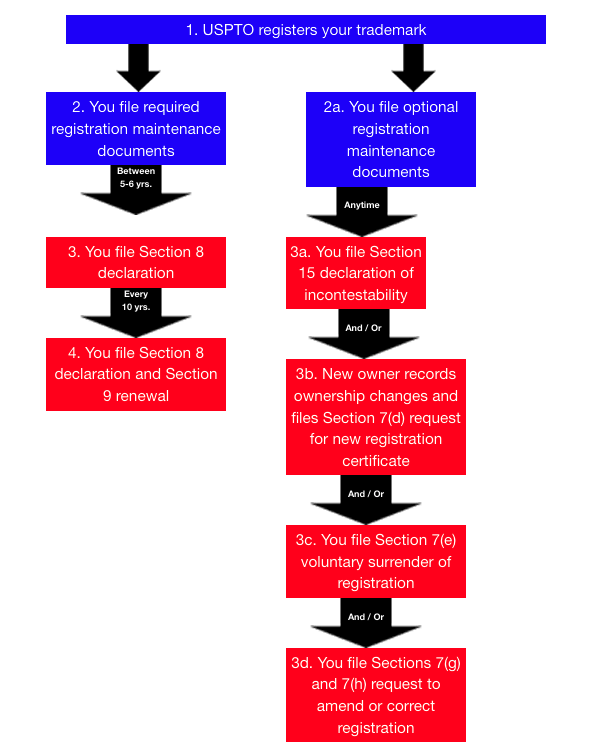
While trademarks do not necessarily expire, there are steps you must take to prove to the USPTO that your trademark is still being used in commerce. This is what’s known as post-registration trademark maintenance. Failure to comply with post registration maintenance can result in your trademark being cancelled.
Here are the requirements for maintaining your trademark registration:
Between the fifth and sixth anniversary of your mark’s registration date, you must submit form Section 8: Declaration of Use, a specimen, and associated fees to the USPTO.
Between the ninth and tenth anniversary of your mark’s registration date, you must submit form Section 8 and form Section 9: Application for Renewal, and any associated fees to the USPTO.
Every 10 years after your mark’s tenth anniversary date, you must submit forms Section 8, Section 9, and any associated fees to the USPTO.
Can My Trademark Accidentally Expire? A Common Error to Avoid
Trademark registration maintenance can become complex, especially if your registration includes many services or goods. Every time you complete your maintenance documents, you must ensure that the trademark is still being used on every item or service identified in the registration. Furthermore, you must submit an appropriate specimen for each good or service identified.
If you’ve stopped selling any goods or services under your mark, then be sure to delete them when filing your maintenance documents. Having an inaccurate record of what goods and services your mark is being used with can result in your entire trademark registration being cancelled. This is a fairly common error made by many small business owners, which has resulted in them spending additional time and money to get everything sorted out.
One way around this, some have argued, is to file separate trademark applications for each product or service you are using your trademark on. That way, any errors when filing maintenance documents for one specific product or service won’t impact the trademark registration on other products or services. Of course, this also creates a lot more paperwork and requires separate fees for each submission. This may not be an appropriate course of action for everyone. Consult with a trademark attorney before you take this approach.
Trademark Maintenance Should be Taken Seriously
Ultimately, ensuring you submit accurate trademark maintenance documents on time is up to you and the USPTO can be ruthless in enforcing its strict time-based deadlines. It can be a lot to keep track of, especially if you are a small business owner who is focused on growing your business and it is undoubtedly worthwhile to speak with a speak with a trademark attorney who can help make sure that you submit all of these documents on time and keep your trademark registration in good standing.
Someone is Using My Trademark, Now What?
Trademark law is challenging because of its subjectivity (does this mark looks too much like that mark?) and the devil is in the details.Trademark Registration can be easy with a an experienced Trademark Lawyer. Let’s dig in.
Well, How Similar is the Other Trademark?
Once the New York trademark attorney determines that the trademark is at least theoretically eligible for admission to the USPTO, the trademark lawyer must next ascertain whether or not the mark is already taken. In the event that it becomes apparent that the trademark is in part already in use (for a similar set of goods/services), a crafty trademark attorney will consider the most fundamental question of trademark law; is the applicant’s new mark so similar to the existing mark as to lead to consumer confusion and cause a buyer to believe the product (bearing the mark) belongs to the later applicant, rather than the initial trademark holder? In order to make this determination, the trademark attorney will employ the Polaroid Factor Test (famously used in Polaroid Corp. v. Polarad Elect).
Trademark Infringement Under the Polaroid Factor Test
The Polaroid factor test is used by Judges to determine whether or not trademark infringement has occurred and consists of eight points and while each factor is important, they do not all need to satisfied.
The strength of the mark.
The degree of similarity between the two marks.
The proximity of the products/services.
The likelihood that the prior owner will bridge the gap.
Actual confusion.
The defendant’s good faith in adopting its own mark.
The quality of the defendant’s product.
The sophistication of the buyers
Taken in its totality, the test signifies the meta-objective of ensuring a buyer will not experience confusion as to the source of the product bearing the mark. The more similar the prospective mark is to the original, the greater likelihood of confusion and therefore the less likely the mark may be registered.
What are the Penalties for Trademark Infringement?
Undoubtedly, ever situation is different but as a general matter, most “penalties” for trademark infringement, assuming the aggrieved party takes legal action, come in the form of Injunctions and Monetary compensations. An Injunction simply means that a court orders the offending party (assuming that the court agrees that the defendant did indeed do something wrong) to immediately stop using the infringing trademark. Monetary penalties can be frankly a bit trickier to unravel but under the Lanham Act, monetary remedies entail five different categories of relief to compensate for trademark infringement:
The rewarding of the Infringer’s Profits to the Plaintiff
The rewarding of the actual damages sustained by the trademark owner as a result of the infringement
Royalty fees representing some amount due as a result of damages
Attorneys fees
Costs
However, just because the Lanham Act provides each of these options as theoretically available to the Plaintiff, it is exceedingly rare that the Plaintiff would be awarded all of these options; Attorneys fees in particular is challenging to obtain and will only be granted under very rare circumstances. Indeed, Section 1117(a) states that, “…court in exceptional cases may award reasonable attorney fees to the prevailing party” but it does not explicitly define what those exceptional circumstances may look like. In the end, damages are available to plaintiffs when they can prove that there was indeed actual confusion and unjust enrichment by the infringing party. It is obviously therefore critical for aspiring trademark applicant’s to conduct a robust trademark search before deciding on a brand to mitigate against the possibility of infringing on another party’s trademark rights. These trademark searches and analyses must be done in the context of the Likelihood of Confusion test, asking not only if the prospective trademark already exists but also whether any marks that are too similar given the products/services sold are already in use.
If I Only Provide My Services in New York City, Can I Still Obtain a Federal Trademark?
This is an excellent question. Ultimately, to obtain a federal trademark, it must be used in “interstate-commerce” meaning that your services must be provided in at least two states. If you are presently only providing your services in New York City, we can simply file an Intent to Use application. The intent-to-use application allows the applicant to reserve the right to use the trademark once it is ready to be used in interstate commerce.
I Have Expanded My Business and Now Serve Customers Outside of New York City – Can I Now File my Trademark Statement of Use?
Once your trademark is in use in interstate commerce (meaning that you are selling your products/services to customers outside of New York City), you may file a Statement of Use with the USPTO to complete the registration process. If the statement of use is accepted, the USPTO will issue a registration certificate for the trademark. What is a Statement of Use? Simply, the statement of use must include a verified specimen showing the trademark being used in commerce, the date of the first use of the trademark in commerce, and a description of the goods or services associated with the trademark. The statement of use allows the USPTO to determine if the trademark is being used in compliance with the requirements of the Lanham Act and if it is eligible for registration. If the statement of use is accepted, the USPTO will issue a registration certificate for the trademark, which provides the owner with exclusive rights to use the mark in connection with the identified goods or services.
As Far As I Know, No Other Businesses in New York City Are Using My Name. Do I Need To Conduct A Trademark Search Before Filing My Application?
While there is no mandate that says you must conduct a trademark search before submitting your trademark application, it is undoubtedly wise to do so. Remember, you are about to file a Federal Trademark Application which means that even though no other businesses in New York City may be using your name, it is possible that your name is in use in other states. A proper trademark search will help uncover any sufficiently similar trademarks, which may block the approval of your desired trademark.
Do I Need To Sell a Product Or Service To Obtain a Registered Trademark?
No, you do not necessarily need to sell a product or service in order to obtain a registered trademark. While using a trademark in commerce is a key requirement for obtaining and maintaining trademark protection, there are specific trademark categories and circumstances where you can seek trademark registration without having sold a product or service. Here are a few scenarios:
Intent-to-Use Trademark Applications: In many countries, including the United States, you can file an “intent-to-use” (ITU) trademark application. This allows you to apply for a trademark before you have actually used it in commerce. However, you will need to demonstrate actual use in commerce before the trademark registration is granted. Once the trademark is registered, it will be retroactive to the date of your ITU application.
Trademark Registration for Services: If your intention is to offer services rather than physical products, you can apply for a service mark, which is a type of trademark used to protect services. In this case, you don’t need to have a physical product to obtain a trademark.
Trademark Registration for Future Products/Services: You can also apply for a trademark to protect a brand name or logo that you plan to use in the future for products or services. This allows you to secure trademark rights in advance of launching your business or offering your products or services.
Defensive Trademark Registration: Some individuals and entities register trademarks defensively to prevent others from using those marks. This strategy is often used by large corporations to protect their brand names and logos, even if they don’t currently offer specific products or services under those marks.
It’s important to note that the requirements and procedures for trademark registration can vary by country, so it’s advisable to consult with a trademark attorney or the relevant government trademark office (e.g., the United States Patent and Trademark Office in the U.S.) to understand the specific rules and options available in your jurisdiction. Additionally, maintaining proper records of your trademark use and consulting with legal professionals can help you navigate the trademark registration process effectively.
What Should I Register First: The Name Of My Business Or My Brand Logo?
Deciding whether to register the name of your business or your brand logo first depends on several factors, including your business strategy and priorities. Both the business name and logo are important elements of your brand identity, and each has its own considerations when it comes to trademark registration. Here are some factors to consider:
Business Name Registration:
Priority of Brand Identity: If your business’s primary identifier is its name (e.g., “ABC Consulting Services”), and you plan to use this name prominently in marketing and communication, it makes sense to start by registering the business name as a trademark or business name with the relevant government authority.
Versatility: A business name is versatile and can be used across various product or service lines if you have a diversified business. This can provide broader protection.
Logo Registration:
Unique Visual Identity: If your brand’s visual identity, represented by a distinctive logo, is a key element in distinguishing your products or services, you may want to prioritize registering the logo as a trademark.
Logo-Based Branding: Some businesses heavily rely on their logo for brand recognition (e.g., Apple’s apple logo). If your logo plays a central role in your branding, you may want to secure its protection first.
In many cases, businesses choose to register both their business name and logo to ensure comprehensive brand protection. Here’s a general sequence to consider:
Business Name Registration: Start by registering your business name as a trademark or business name, especially if it is a unique and essential part of your brand identity. This provides protection for the name itself.
Logo Registration: If your logo is distinctive and plays a significant role in your brand recognition, consider registering it as a separate trademark. This will protect the specific design elements of the logo.
Combined Registration: Some businesses choose to register a combined trademark that includes both the business name and the logo. This can provide protection for the combination of the two, making it clear that they are part of the same brand.
Consider Legal Advice: It’s highly advisable to consult with a trademark attorney or legal professional who specializes in intellectual property to help you determine the best strategy for your specific business needs and to navigate the trademark registration process effectively.
Remember that the rules and procedures for trademark registration vary by country, so it’s important to understand the requirements in your jurisdiction and ensure compliance with trademark laws and regulations.
What Is A Fanciful Trademark?
A fanciful trademark is a type of trademark that is inherently distinctive and immediately eligible for trademark protection because it consists of a word, phrase, symbol, or design that has been invented or created specifically for use as a trademark. Fanciful trademarks have no prior meaning in the language and are typically coined terms or completely made-up words that have no connection to the products or services they represent. Because they are entirely unique and unrelated to any existing words or concepts, fanciful trademarks are considered strong and provide a high level of protection.
Examples of fanciful trademarks include:
Kodak – This term was coined by the Eastman Kodak Company and had no meaning before it was used as a brand name for photographic equipment and film.
Xerox – Xerox Corporation created this word to represent its photocopying products and services.
Exxon – The energy company ExxonMobil created this name for its brand, and it has no prior meaning in the English language.
Clorox – The Clorox Company invented this word to brand its line of bleach products.
Fanciful trademarks are often preferred by businesses because they are distinctive, memorable, and provide strong legal protection. When a fanciful trademark is registered, it means that the owner has exclusive rights to use that mark in connection with the specified goods or services. Competitors are generally prohibited from using a similar or confusingly similar mark in a way that could cause consumer confusion.
In contrast to fanciful trademarks, other categories of trademarks include:
Arbitrary Trademarks: These are existing words or symbols that have no connection to the products or services they represent. For example, “Apple” for computers and electronics.
Suggestive Trademarks: These trademarks indirectly suggest a quality or characteristic of the product or service but don’t directly describe it. For example, “Netflix” suggests a network of interconnected content without explicitly describing it.
Descriptive Trademarks: These marks directly describe a characteristic, quality, or ingredient of the product or service. They are generally less distinctive and may require evidence of acquired distinctiveness for registration.
Generic Terms: These are common, generic words that describe the product or service itself and cannot be registered as trademarks. For example, “computer” cannot be trademarked for computers.
Fanciful trademarks, being the most distinctive and protectable, are often sought after by companies looking to build strong brand recognition and prevent others from using similar marks in their industry.
How Long Does The Trademark Application Process Take?
The duration of the trademark application process can vary significantly depending on several factors, including the jurisdiction where you are filing the application and the complexity of the application itself. Generally, the trademark application process can take several months to multiple years to complete. Here is an overview of the typical timeline:
1. Filing the Application: The first step is to submit your trademark application to the relevant trademark office. This includes providing the necessary information, such as the mark itself, the goods or services associated with the mark, and any supporting documentation. The initial application can usually be filed online or by mail.
2. Examination: After your application is filed, it undergoes an examination by the trademark office. The examination process involves reviewing the application for compliance with formalities, such as proper classification of goods and services, and assessing the distinctiveness and registrability of the mark. This examination can take several months to complete.
3. Office Actions and Responses: If the trademark office raises any objections or issues during the examination process, they will issue an office action detailing the concerns. You are given a specific period (usually a few months) to respond to the office action and address any objections raised. The back-and-forth correspondence between you and the trademark office can extend the overall timeline of the application process.
4. Publication and Opposition (if applicable): After the examination is successfully completed, the trademark may be published in an official gazette or publication to allow third parties to oppose the registration within a specified period. The opposition period, if applicable, can further prolong the process. Not all jurisdictions have an opposition system.
5. Registration or Final Decision: If there are no oppositions or if any oppositions are successfully resolved in your favor, the trademark office will issue a registration certificate. The timing for registration varies, but it can take several months from the end of the opposition period. However, if the trademark office denies the registration, you may have the option to appeal the decision or take other appropriate legal actions, which can significantly extend the process.
It’s important to note that the timeline provided above is a general overview and can vary significantly depending on the jurisdiction and specific circumstances of each application. It is advisable to consult with a trademark attorney or intellectual property professional who can guide you through the process and provide more accurate estimates based on your specific situation.
How Long Does a Trademark Last?
The duration of a trademark’s protection can vary depending on several factors, including the country in which it is registered and how well the trademark owner maintains and enforces their trademark rights. Here are some general guidelines:
In the United States:
A trademark registration in the United States, when properly maintained, can last indefinitely.
Initially, a U.S. trademark registration is granted for ten years. However, it can be renewed indefinitely in subsequent ten-year periods as long as the trademark owner continues to use and protect the mark.
To maintain a U.S. trademark, the owner must file maintenance documents (such as a Declaration of Use) between the 5th and 6th year after registration and renew the registration between the 9th and 10th year after registration. After the initial renewal, subsequent renewals are required every ten years.
In Other Countries:
Trademark laws and registration periods can vary widely from country to country. In many countries, trademark registrations are also initially granted for a specified number of years (often 10 years), with the possibility of renewal.
The renewal requirements and fees can differ from one country to another, so it’s important for trademark owners to be aware of the specific rules and deadlines in each jurisdiction where they have registered trademarks.
Maintenance and Use:
It’s important to emphasize that trademarks require continuous use and protection to remain valid and enforceable. If a trademark owner stops using the mark or fails to protect it from infringement, they may lose their rights to the mark.
Trademark owners are typically required to demonstrate ongoing use of the mark in connection with the registered goods or services to maintain their registrations.
Incontestability Status:
In the United States, after a trademark has been registered for five consecutive years and has been continually used in commerce during that time, it becomes eligible for “incontestability” status. An incontestable trademark enjoys stronger legal protection and is more difficult to challenge.
However, even incontestable trademarks must still be renewed according to the renewal schedule.
International Registrations: For international trademark registrations under the Madrid Protocol, the renewal process is generally linked to the renewal of the basic application or registration in the home country of the applicant. It’s important to note that not all countries are parties to the Madrid Protocol, so international trademark protection can involve multiple jurisdictions and different renewal requirements.
It’s crucial for trademark owners to keep track of renewal deadlines, continue using their trademarks in commerce, and enforce their rights to protect their brand identity effectively. Failure to do so can result in the loss of trademark protection. Legal advice from a trademark attorney can be valuable in navigating the complexities of trademark maintenance and renewal.
Can I Request An Expedited Approval Of My Trademark Registration?
Yes, in some cases, you may be able to request expedited or accelerated processing of your trademark application. The availability of expedited approval and the specific procedures for requesting it vary depending on the jurisdiction where you are seeking trademark registration. Here are a few scenarios where expedited processing may be possible:
1. Fast-Track or Accelerated Examination Programs: Some trademark offices offer fast-track or accelerated examination programs that allow applicants to expedite the examination process. These programs are often available for specific types of trademarks or under certain conditions, such as marks related to green technology, small businesses, or marks that are deemed of particular importance to the economy. Each trademark office has its own eligibility criteria and guidelines for these programs.
2. Intent-to-Use Applications: In certain jurisdictions, if you have filed an intent-to-use application, you may have the option to expedite the examination process by filing a request to expedite along with the application. This is typically available when there is a genuine need to obtain registration quickly due to business considerations or time-sensitive marketing plans.
3. Special Circumstances: In exceptional cases, such as when there is an urgent need for trademark protection due to ongoing infringement or a pending legal dispute, you may be able to request expedited processing based on special circumstances. You would typically need to demonstrate a compelling reason for the expedited treatment, and the trademark office will evaluate the request on a case-by-case basis.
It is important to note that expedited processing usually involves additional fees, and the specific requirements and procedures for requesting it can vary among trademark offices. Consulting with a trademark attorney or intellectual property professional who is familiar with the procedures and requirements of the relevant jurisdiction is advisable. They can provide guidance on whether expedited processing is available in your specific situation and assist you with the necessary steps to request it.
What is TEAS?
If you are a New York City business owner and are ready to file a federal trademark application, you will be using TEAS. TEAS stands for the Trademark Electronic Application System. It is an online system developed by the USPTO that allows applicants to file and manage their trademark applications electronically. The TEAS system offers various application options, including TEAS Plus, TEAS RF (Reduced Fee), and TEAS Regular, each with its own requirements and benefits. TEAS Plus is a streamlined application process that requires the applicant to meet certain strict requirements and includes a lower filing fee than the TEAS Regular option. TEAS RF provides a lower filing fee than the TEAS Regular option but requires the applicant to meet certain additional requirements. The TEAS Regular option offers more flexibility in terms of application requirements but has a higher filing fee than the other options. The TEAS system also allows for online management of trademark applications, including checking the status of an application, submitting responses to Office Actions, and paying maintenance fees. TEAS is easy to use and gives you 60 minutes to complete your application, which should be more than enough time.
Is There A Difference Between a Trademark and a Service Mark?
Yes, there is a difference between a trademark and a service mark. While both serve as identifiers of the source of goods or services, the distinction lies in the types of offerings they represent.
A trademark is used to distinguish and protect marks associated with goods or products. It can be a word, phrase, symbol, design, or combination thereof that helps consumers recognize and differentiate the source of particular goods in the marketplace. For example, a trademark can identify the brand of a specific clothing line or a unique logo associated with a consumer product.
On the other hand, a service mark serves a similar purpose but is specifically used to identify and protect marks associated with services rather than physical goods. It is used to distinguish and indicate the source of services provided by a business or individual. For instance, a service mark may be used to identify a specific consulting firm, a restaurant chain, or a software development service.
In practice, the legal protections and requirements for trademarks and service marks are typically the same. The distinction between the two lies primarily in the nature of the offerings they identify. However, it’s worth noting that in some jurisdictions, the term “trademark” is used more broadly to encompass both goods and services, and the same registration process and legal principles apply to both.
Ultimately, whether you should pursue a trademark or a service mark depends on the nature of your business and the type of offerings you provide. It’s recommended to consult with a trademark attorney or intellectual property professional to understand the specific requirements and implications in your jurisdiction and ensure proper protection for your brand identity.
How Can I Determine If a Trademark Is Available?
To determine if a trademark is available, you can follow these steps:
1. Preliminary Search: Start by conducting a preliminary search to check if a similar or identical trademark is already registered or pending with the relevant trademark office. You can use online databases provided by trademark offices, such as the United States Patent and Trademark Office (USPTO) or the European Union Intellectual Property Office (EUIPO), or utilize commercial trademark search tools. This will help identify potential conflicts and existing trademarks that may be similar to yours.
2. Search Common Law Sources: In addition to registered or pending trademarks, search common law sources to identify unregistered trademarks that may be in use but not yet officially registered. This can include searching the internet, social media platforms, business directories, and industry-specific publications. Look for any marks that are similar to your proposed trademark and are used in connection with similar or related goods or services.
3. Engage a Trademark Attorney: Consider consulting with a trademark attorney or an intellectual property professional who can assist you with a comprehensive trademark search. They have access to more extensive databases, expertise in analyzing search results, and can provide legal advice regarding potential conflicts or risks associated with your proposed trademark.
4. Evaluate Similarity and Potential Conflicts: Assess the similarity between your proposed trademark and the existing trademarks you found during your search. Look for marks that are similar in sound, appearance, or meaning and are used in connection with similar or related goods or services. Evaluate the potential risk of confusion or infringement that may arise if you proceed with your chosen mark.
5. Conduct a Clearance Search: Consider conducting a comprehensive trademark clearance search, also known as a full availability search or clearance opinion. This search is typically conducted by professional search firms or trademark attorneys and involves a detailed analysis of existing trademarks and common law sources. It provides a more thorough assessment of the availability and potential risks associated with your proposed trademark.
6. Consult with Legal Professionals: Finally, consult with a trademark attorney or intellectual property professional to review the search results and obtain legal advice. They can help interpret the search findings, assess the likelihood of successfully registering your trademark, and provide guidance on the next steps to take based on the search results.
Performing a thorough trademark search is crucial to identify potential conflicts and assess the availability of your proposed trademark. It helps reduce the risk of infringing on existing trademarks and increases the chances of a successful trademark registration.
What Is a Trademark’s Specimen?
A trademark specimen, often referred to as a “specimen of use,” is a real-world example or evidence that demonstrates how a trademark is being used in commerce in connection with specific goods or services. Specimens are an essential part of the trademark registration process as they provide evidence to the trademark office that the mark is being used in a way that meets the legal requirements for trademark protection.
Here are some key points to understand about trademark specimens:
Evidence of Use: Specimens serve as tangible proof that the trademark is actively being used in commerce. This is crucial because trademark rights are typically granted based on actual use of the mark in the marketplace.
Requirement for Registration: To register a trademark in many jurisdictions, including the United States, you must submit an acceptable specimen of use as part of your trademark application. The specimen shows that you are using the trademark in connection with the specified goods or services.
Types of Specimens: The type of specimen you submit depends on whether your mark is used in connection with goods or services:
For goods (products), a specimen may be a label, tag, packaging, product itself, or a photograph of the product displaying the trademark.
For services, a specimen may be a screenshot of a website displaying the trademark in connection with the services, a brochure, an advertisement, or other promotional materials.
Acceptable Specimens: Trademark offices have specific requirements for what constitutes an acceptable specimen. It must clearly show the trademark in use, and the use must be in a manner that associates the mark with the relevant goods or services.
Use in Commerce: The specimen should demonstrate that the trademark is being used in interstate commerce (commerce that crosses state lines in the U.S.) if you are seeking federal registration in the United States.
Date of First Use: The specimen can also serve to establish the date of first use in commerce, which can be important in determining priority of rights in cases of trademark disputes.
Additional Requirements: Some trademark offices may have additional requirements for specimens, such as size, quality, and clarity. It’s essential to review the specific guidelines of the trademark office where you are filing your application.
Intent-to-Use Applications: If you are filing an “intent-to-use” trademark application in the U.S., you will initially submit a “specimen” showing how you intend to use the mark. After the mark is registered, you’ll need to submit an additional specimen of actual use to maintain the registration.
In summary, a trademark specimen is a piece of evidence that demonstrates how your trademark is being used in commerce in connection with specific goods or services. It is a critical component of the trademark registration process, as it verifies that your mark is actively being used in a way that qualifies for legal protection.
What Is The Official Gazette?
In the context of the USPTO (United States Patent and Trademark Office), the Official Gazette is a weekly publication that contains information related to trademarks and patents. Specifically, the Trademark Official Gazette is published every Tuesday and includes information about newly registered trademarks, trademarks that have been renewed, and trademarks that are available for opposition. The Trademark Official Gazette serves as a public notice of new and renewed trademarks, providing the public with an opportunity to oppose a trademark registration if they believe it may cause confusion with their own trademark. Once a trademark is published in the Official Gazette, interested parties have 30 days to file an opposition. In addition to information about trademark registrations, the Trademark Official Gazette may also contain other information related to trademark law and practice, including changes to trademark rules and procedures, notices of public meetings, and other announcements. The Patent Official Gazette, on the other hand, is published every Tuesday and contains information related to patents, including notices of new patents, patent reexaminations, and patent assignments. Both the Trademark Official Gazette and the Patent Official Gazette are important resources for anyone involved in trademark or patent law, including attorneys, applicants, and trademark or patent owners.
Can I Use A Trademark Without Registering It?
Yes, you can use a trademark without registering it. Trademark rights can be established through common law by simply using the mark in commerce to identify and distinguish your goods or services. This is known as a common law trademark.
Here are some key points to understand about using a trademark without registration:
1. Common Law Rights: When you use a mark in connection with your goods or services, you automatically acquire common law trademark rights in the geographic areas where you are using the mark. These rights generally provide you with some level of protection against others using a similar or confusingly similar mark in the same or related industry.
2. “TM” Symbol: Even without registration, you can use the “TM” symbol to indicate that you are claiming common law trademark rights in the mark. This symbol serves as notice to others that you consider the mark to be your trademark.
3. Limited Protection: Common law trademark rights offer limited protection compared to registered trademarks. They are generally restricted to the specific geographic areas where you are using the mark and may be more difficult to enforce. Registering your trademark provides stronger and broader protection nationwide or in the countries where it is registered.
4. Trademark Registration Benefits: Registering your trademark with the appropriate trademark office provides several benefits, including a legal presumption of ownership, nationwide or international protection, the ability to use the ® symbol, and easier enforcement of your rights. Registration can also act as a deterrent to others who may consider using a similar mark.
5. Registration Process: To obtain a registered trademark, you must file an application with the relevant trademark office and meet the registration requirements, which typically include distinctiveness, use in commerce, and avoidance of conflicts with existing trademarks. The registration process can take time and involves fees.
While registration is not mandatory, it is often recommended to seek registration for valuable trademarks or marks that you plan to use extensively. Registering your trademark provides additional legal protections and strengthens your rights in case of infringement or legal disputes.
It’s important to note that trademark laws vary by country, and some jurisdictions may require registration to establish trademark rights. Consulting with a trademark attorney or intellectual property professional is recommended to understand the specific requirements and implications in your jurisdiction.
Can I Trademark a Phrase?
Yes, you can trademark a phrase under certain conditions. Phrases, like other elements, such as words, symbols, logos, and designs, can serve as trademarks if they meet the legal requirements for trademark protection. Here are the key factors to consider when trademarking a phrase:
Distinctiveness: To be eligible for trademark protection, a phrase must be distinctive. Distinctiveness means that the phrase is capable of identifying the source of goods or services and distinguishing them from those of others. Trademarks fall into several categories of distinctiveness:
Fanciful or Arbitrary: These are the most distinctive and easily protectable. Fanciful phrases are entirely made-up and have no meaning (e.g., “Xerox” for photocopiers). Arbitrary phrases are real words used in an unrelated context (e.g., “Apple” for computers).
Suggestive: Suggestive phrases indirectly suggest qualities or characteristics of the goods or services but do not explicitly describe them (e.g., “Microsoft” for software).
Descriptive: Descriptive phrases directly describe the goods or services and are generally not eligible for trademark protection unless they have acquired secondary meaning (e.g., “Super Fast” for delivery services).
Generic: Generic phrases are common terms that describe the product or service itself and cannot be trademarked (e.g., “Computer” for computers).
Use in Commerce: To obtain trademark protection, you must use the phrase in commerce in connection with specific goods or services. The phrase should be used as a source identifier for those goods or services. Proof of use in commerce is typically required as part of the trademark registration process.
Distinctiveness and Likelihood of Confusion: The phrase you want to trademark should not be confusingly similar to existing trademarks for similar goods or services. Trademark offices examine applications to ensure that they do not conflict with existing registrations.
Registration Process: You can apply for a trademark registration with the appropriate government agency in your jurisdiction, such as the United States Patent and Trademark Office (USPTO) in the United States. The registration process involves submitting an application, paying the required fees, and providing evidence of use (a specimen) showing the phrase as used in commerce.
Duration: If granted, trademark protection can last indefinitely as long as the mark is continuously used in commerce and renewed according to the required schedule.
Enforcement: Once registered, you have the exclusive right to use the phrase in connection with the specified goods or services, and you can take legal action against others who use it without permission.
It’s important to conduct a thorough search to ensure that your desired phrase is available for trademark registration and consult with a trademark attorney to navigate the application process effectively. Trademark laws and requirements can vary by country, so it’s essential to understand the specific rules and procedures in your jurisdiction.
Can I Trademark a Logo?
Yes, you can trademark a logo, and it’s a common practice to do so to protect your brand identity and prevent others from using a similar logo in connection with similar goods or services. Trademarking a logo provides legal protection for the specific design elements and visual representation of your brand. Here are the key steps involved in trademarking a logo:
Design a Distinctive Logo:
Your logo should be unique and distinctive. A well-designed logo helps your brand stand out and is easier to protect through trademark registration.
Conduct a Trademark Search:
Before you begin the registration process, it’s crucial to conduct a comprehensive trademark search to ensure that your logo does not conflict with existing trademarks. This search helps identify potential trademark conflicts that could result in your application being denied.
Choose the Appropriate Trademark Class:
Trademarks are registered in specific classes based on the goods or services they represent. You’ll need to select the appropriate class or classes that align with the products or services associated with your logo.
Prepare and File a Trademark Application:
You’ll need to submit a trademark application to the relevant government authority, such as the United States Patent and Trademark Office (USPTO) in the United States. The application will include details about your logo, the class of goods or services, and the basis for filing (e.g., current use or intent to use).
Pay the Required Fees:
Trademark registration typically involves filing fees, which can vary depending on the jurisdiction and the number of classes you select. Be sure to budget for these fees.
Submit a Specimen of Use:
If your logo is already in use in commerce at the time of filing, you will need to provide a specimen of use as evidence. The specimen is typically an image or photograph showing how the logo is used in connection with the specified goods or services.
Examination and Registration:
The trademark office will review your application to ensure it meets all legal requirements. This includes assessing the distinctiveness of your logo and conducting a search for potential conflicts. If your application is approved, your logo will be registered as a trademark.
Trademark Maintenance and Renewal:
Trademark registrations require ongoing maintenance, including periodic renewals. You must continue to use the logo in commerce and renew the registration according to the required schedule to maintain your trademark rights.
Enforce Your Trademark Rights:
With a registered trademark, you have the exclusive right to use the logo in connection with the specified goods or services. You can take legal action against others who use a similar logo without permission.
Trademarking a logo is an important step in protecting your brand identity, building brand recognition, and preventing infringement. It’s advisable to consult with a trademark attorney who can assist you throughout the registration process and provide guidance on maintaining and enforcing your trademark rights.
Can I Trademark a Color?
Yes, in some cases, you can trademark a color, but it is generally more challenging to obtain a color trademark compared to traditional word or design marks. To trademark a color, you must meet specific legal requirements, demonstrate that the color has acquired distinctiveness in connection with your goods or services, and provide evidence of how the color is used as a source identifier for your brand. Here are some key considerations:
Distinctiveness: To qualify for a color trademark, the color must be inherently distinctive or have acquired distinctiveness (secondary meaning) through extensive and exclusive use. Inherently distinctive colors are those that are unique and unlikely to be associated with a particular product or service category.
Secondary Meaning: If the color is not inherently distinctive, you can still seek trademark protection if you can demonstrate that the color has acquired secondary meaning in the minds of consumers. This means that consumers recognize the color as identifying your brand’s goods or services.
Use as a Trademark: To obtain a color trademark, you must show that you use the color in a distinctive and consistent manner to identify and distinguish your goods or services. This often involves using the color on packaging, labels, products, or in advertising.
Functionality: Colors that serve a functional purpose (e.g., a color used in the industry to indicate the type or quality of a product) are generally not eligible for trademark protection. The color must primarily serve as a source identifier.
Competition: Consider whether trademarking a color is necessary to protect your brand and prevent consumer confusion. If the color is central to your brand identity and plays a significant role in distinguishing your products or services, it may be worth pursuing a color trademark.
Registration Process: The trademark registration process for a color mark is similar to that of other trademarks. You’ll need to submit an application to the relevant trademark office, provide evidence of use, and demonstrate distinctiveness or secondary meaning. The application will include a detailed description of how the color is used and a color sample.
Examples of Registered Color Trademarks: Some famous examples of registered color trademarks include:
Tiffany & Co.’s distinctive robin’s-egg blue color for jewelry packaging.
UPS’s brown color for its delivery trucks and uniforms.
The pink color used by Owens-Corning for fiberglass insulation.
It’s important to note that obtaining a color trademark can be challenging, and the process may require legal expertise. Trademark laws and regulations regarding color trademarks can vary by jurisdiction, so it’s advisable to consult with a trademark attorney who can assess the viability of trademarking a specific color for your brand and guide you through the application process.
What Is a Trademark Office Action?
A trademark office action is an official communication or written response issued by a trademark examiner or an official at a trademark office, such as the United States Patent and Trademark Office (USPTO) in the United States or the European Union Intellectual Property Office (EUIPO) in the European Union. It is a crucial step in the trademark registration process and serves to inform the applicant of issues or deficiencies with their trademark application. Here are key points to understand about trademark office actions:
Purpose: The primary purpose of a trademark office action is to provide feedback to the applicant regarding the application’s compliance with the legal requirements and regulations governing trademark registration.
Common Issues Addressed: Office actions can raise various issues, including:
Conflicts with existing trademarks: The examiner may identify trademarks that are similar or identical to the applicant’s mark, which could lead to consumer confusion.
Descriptiveness: If the trademark is considered merely descriptive of the goods or services, it may be refused registration.
Specimen of Use: If the applicant provided an inadequate or incorrect specimen of use, the examiner may request clarification or a new specimen.
Classification of Goods or Services: The examiner may question the classification of the goods or services and ask for more specific details.
Formalities: Office actions can also address formalities, such as missing or incorrect information in the application.
Response Required: Upon receiving a trademark office action, the applicant is typically required to respond within a specified period, which can vary by jurisdiction but is often six months or less. Failing to respond within the deadline can result in the abandonment of the application.
Options for Response: Depending on the issues raised in the office action, the applicant can respond in several ways:
Amend the application: The applicant can make changes or amendments to the application to address the examiner’s concerns.
Provide arguments or evidence: In cases where the applicant believes the examiner’s objections are not valid, they can provide legal arguments and evidence to support their position.
Abandon the application: If the issues are insurmountable, the applicant can choose not to respond, which will result in the abandonment of the application.
Consulting with an Attorney: It’s often advisable to consult with a trademark attorney when responding to an office action, especially if the issues are complex or if you plan to provide legal arguments or evidence. An attorney can help craft a well-informed and persuasive response.
Iterative Process: It’s common for trademark applications to receive office actions, and the process can involve multiple rounds of correspondence between the applicant and the trademark office until all issues are resolved or the application is approved for registration.
Successfully addressing and resolving trademark office actions is a crucial step in obtaining trademark registration. It ensures that the trademark complies with the legal requirements and strengthens the protection of the brand.
How Likely Is It To Receive a Trademark Application Rejection?
Statistics show that about 40% of all trademark applications filed with the United States Patent and Trademark Office (USPTO) are approved on their first pass. No office actions, no amendments, no arguments.
What that means is that more than half of all trademark applications will be rejected outright or at least receive an initial office action. An office action is issued by the examining attorney and lists the reasons why your application is being rejected or questions. When you start trademark application process, you want to be prepared for the possibility that you will be among the 60% who don’t get approved right away.
Another reason that your application may not be approved is that it’s been suspended. That means the USPTO is waiting to see the outcome of applications for similar marks filed before yours. While your application hasn’t been outright rejected in this scenario, suspensions can still cause frustrating delays.
Can I Improve My Chances of Trademark Application Approval?
One way to improve the chances of your trademark application being approved is to perform a trademark clearance search prior to submitting your application. This includes searching the Federal Trademark record, state trademark registrations, common law sources, and Internet sources. If you find a mark that’s similar to your desired mark, then it’s best to assume the USPTO will reject it. You should choose a more unique trademark before submitting your application. You can contact a trademark attorney to help you conduct a clearance search and advise you on a trademark registration strategy. Similarly, if you’re submitting an application for a trademark that you think may be subject to refusal, then it would be wise to anticipate the refusal early in the process and plan accordingly. While it may be excessive to actually draft a rebuttal argument, it would be prudent to at least contemplate what sort of argument would be persuasive to defeat an office action. You may also want to have a second “backup” trademark ready to go in case you can’t overturn the examining attorney’s refusal.
Can I Improve My Chances of Application Approval After Initial Rejection?
If your initial trademark application was rejected, you still have the chance to go back to the examining attorney to argue the decision.
One of the best strategies is to reconsider the goods and services in your application. You can delete certain items from the list of identified goods and services, which may help the examining attorney more easily approve your application on the subsequent review.
If the examining attorney has only refused a certain set of goods and services (i.e., issued a partial refusal) consider filing a Request to Divide so the approved items in your application may move forward while you determine a strategy for the rejected items.
How Likely is it to Succeed in Overturning a Second Trademark Rejection?
The Trademark Trial and Appeal Board (TTAB) is the entity that reviews appeals of trademark rejections. The TTAB recently completed an analysis which revealed that when a trademark application was rejected by an examining attorney for the reason of likelihood of confusion, the TTAB upheld that decision on appeal more than 90% of the time. Furthermore, trademark applications that were rejected on the basis of being merely descriptive, the TTAB upheld that decision almost 94% of the time.
Now remember, appeals to the TTAB only occur after you’ve received a second rejection from the examining attorney. As you can see, your chances of successfully convincing the TTAB to overturn an examining attorney’s decision are very low. So, you want to consider the time and involved with appealing to the TTAB before proceeding.
Can I Transfer My Trademark To Someone Else?
Yes, you can transfer your trademark to someone else through a process known as a trademark assignment. A trademark assignment involves transferring some or all of your rights and interests in the trademark to another party. This transfer can be permanent or temporary and may encompass the entire trademark or only specific rights associated with it. Here are the key points to understand about trademark assignments:
Reasons for Trademark Assignment:
There are various reasons for transferring a trademark, including selling a business, licensing the trademark to others, restructuring a company, or simply transferring ownership of the trademark to another individual or entity.
Types of Trademark Assignments:
There are two primary types of trademark assignments:
Assignment of Ownership: This involves transferring all rights, title, and interest in the trademark to another party. The new owner becomes the exclusive holder of the trademark.
Assignment of Rights: This involves transferring specific rights associated with the trademark, such as the right to use the mark for certain goods or services, but not the full ownership of the trademark.
Recording the Assignment: To ensure the validity of a trademark assignment, it is advisable to record the assignment with the relevant trademark office. In the United States, for example, this is done with the United States Patent and Trademark Office (USPTO). Recording the assignment provides public notice of the transfer and helps protect the interests of both parties involved.
Assignment Agreement: A written agreement between the current owner (assignor) and the new owner (assignee) is typically required to document the terms and conditions of the assignment. This agreement should specify the rights being transferred, any limitations or restrictions, and any financial considerations, such as the purchase price or royalties in the case of licensing.
Notification to Licensees and Business Partners: If the trademark is being assigned as part of a business sale or restructuring, it’s important to notify licensees, business partners, and customers of the change in ownership to avoid confusion.
Maintaining the Trademark: The new owner of the trademark is responsible for maintaining and enforcing the mark, including renewing the registration, if applicable. Failure to do so could result in the loss of trademark rights.
International Considerations: If your trademark is registered in multiple countries, you may need to execute separate assignments for each jurisdiction or follow the specific requirements of each trademark office.
Legal Assistance: It is advisable to consult with a trademark attorney when executing a trademark assignment. Legal professionals can help draft the assignment agreement, ensure compliance with trademark laws, and navigate the administrative aspects of recording the assignment with the relevant trademark office.
Overall, trademark assignments are common transactions in the world of intellectual property and are used for various business and legal purposes. Whether you are transferring a trademark or acquiring one, it’s essential to follow the proper legal procedures and documentation to protect the interests of all parties involved.
Can I License My Trademark To Others?
Yes, you can license your trademark to others, allowing them to use your trademark in connection with specific goods or services, as long as you retain ownership of the trademark. Licensing a trademark is a common practice and can be a valuable business strategy. Here are some key points to consider when licensing your trademark:
Types of Trademark Licensing:
There are different types of trademark licenses, including:
Exclusive License: Grants exclusive rights to the licensee for the specified goods or services, meaning no one else, including the trademark owner, can use the trademark in connection with those goods or services.
Non-Exclusive License: Allows multiple licensees to use the trademark for the same or similar goods or services.
Sublicense: Permits the primary licensee to grant sublicenses to others, expanding the use of the trademark.
License Agreement: A written license agreement is essential to outline the terms and conditions of the license, including the scope of use, territory, duration, quality standards, and any royalties or fees to be paid by the licensee. The agreement should clearly define the rights and responsibilities of both parties.
Quality Control: As the trademark owner, you have a legal obligation to maintain quality control over the goods or services associated with your trademark. This ensures that the trademark’s reputation is not damaged by substandard products or services. Quality control provisions should be included in the license agreement.
Record Keeping: It’s important to keep detailed records of the licensed products or services, the licensees, and any financial transactions related to the license. This documentation can be useful in case of disputes or for maintaining the integrity of your trademark.
Termination Rights: The license agreement should specify the conditions under which the license can be terminated, such as breaches of the agreement or failure to meet quality standards.
Protecting Your Trademark: While you are granting others the right to use your trademark, you must continue to actively protect and enforce your trademark rights to prevent misuse and dilution.
Geographic Scope: You can grant licenses for specific geographic territories or on a broader, national or international scale, depending on your business strategy and the demand for your trademark.
Renewal and Duration: The license agreement should specify the duration of the license and any renewal options. Typically, trademark licenses are granted for a set term and are renewable.
Consult Legal Professionals: It’s advisable to consult with a trademark attorney when drafting a license agreement. Legal professionals can help ensure that the agreement complies with trademark laws and protects your interests.
Licensing your trademark can generate revenue, increase brand exposure, and expand your brand’s reach. However, it’s essential to carefully consider potential licensees and monitor the use of your trademark to maintain its integrity and value.
If My Trademark Is Registered In The United States Is It Protected In Other Countries As Well?
No, a trademark registered in the United States does not automatically provide protection in other countries. Trademark protection is territorial, which means that it generally applies only within the borders of the country where the trademark is registered. If you want to protect your trademark in other countries, you must apply for trademark registration in those countries individually or consider international trademark registration options.
Here are some ways to protect your trademark in other countries:
National Trademark Registrations: File separate trademark applications in each country where you want protection. This involves adhering to the trademark registration requirements and procedures of each individual country.
International Trademark Registration (Madrid System): If your home country is a member of the Madrid Protocol, you can use the Madrid System to file a single international trademark application that extends protection to multiple member countries. This system simplifies the process of seeking trademark protection in multiple countries.
Regional Trademark Systems: Some regions have established regional trademark systems that allow you to apply for trademark protection across multiple countries in that region with a single application. For example, the European Union Intellectual Property Office (EUIPO) handles trademark registrations for all member states of the European Union through the European Union Trade Mark (EUTM) system.
Use and Enforcement of Common Law Rights: In some countries, trademark rights can be established through use of the mark in commerce, even without formal registration. These are known as common law trademark rights. If your trademark is well-known and has been used extensively in a particular country, you may have some level of protection there, although it may not be as strong as registered rights.
Consult with Legal Professionals: International trademark law can be complex, and the requirements and procedures vary from country to country. It’s advisable to consult with trademark attorneys who specialize in international trademark matters to navigate the process effectively.
Consider the Madrid Protocol: If you plan to protect your trademark in multiple countries, especially if you’re based in a member country, consider using the Madrid Protocol for international registration. This system can streamline the process and provide a more cost-effective way to obtain protection in multiple jurisdictions.
In summary, while a U.S. trademark registration provides protection within the United States, it does not automatically extend to other countries. To protect your trademark internationally, you need to follow the relevant trademark registration procedures in each country or region where you seek protection. International trademark registration systems and legal professionals specializing in trademark law can be valuable resources in this process.
Is There Such A Thing As An “International Trademark”?
There is no single “international trademark” that provides worldwide trademark protection in all countries. However, there are international systems and agreements that simplify the process of seeking trademark protection in multiple countries. These systems and agreements aim to make it more efficient for trademark owners to obtain protection in multiple jurisdictions. Here are two notable international trademark systems:
Madrid System for the International Registration of Marks:
The Madrid System is one of the most widely used mechanisms for seeking trademark protection in multiple countries. It is administered by the World Intellectual Property Organization (WIPO).
Under the Madrid System, trademark owners from member countries can file a single international trademark application with WIPO. This application can designate multiple member countries where the owner seeks protection.
The advantages of the Madrid System include streamlined filing procedures, centralized management, and the ability to modify, renew, or expand protection in multiple countries through a single application.
European Union Trade Mark (EUTM):
While not a worldwide system, the EUTM system allows trademark owners to obtain protection in all member states of the European Union (EU) with a single application.
An EUTM registration provides trademark protection in all 27 EU member countries, making it an attractive option for businesses looking to protect their trademarks in the European market.
It’s important to note that these systems facilitate the process of obtaining trademark protection in multiple countries but do not grant a single, uniform trademark that covers the entire world. Trademark protection remains territorial, meaning it is specific to the countries or regions where protection is sought.
In addition to these international systems, some regional trademark systems exist, such as the African Intellectual Property Organization (OAPI) and the African Regional Intellectual Property Organization (ARIPO), which provide trademark registration services for multiple countries within their respective regions.
For trademark protection outside the scope of these international and regional systems, trademark owners must file separate trademark applications in individual countries, taking into account each country’s specific requirements and procedures. To navigate the complexities of international trademark registration effectively, it is advisable to consult with trademark attorneys or professionals experienced in international trademark law.
When Can I Begin Using the TM Symbol? What About the ® Symbol?
The reality is the the TM symbol does not unfortunately carry too much weight, certainly not tantamount to the legal force which comes with the ® symbol. Basically, the TM symbol is designed only to communicate that the trademark carries certain “common law” trademark rights, or rights that are conferred by virtue of the fact that the trademark is used in commerce, but not yet registered. The ® symbol, conversely, communicates that the trademark holder has been granted a fully registered trademark from the United States Patent and Trademark Office (USPTO). The ® symbol can only be used when the mark is indeed federally registered. However, please be assured that the trademark still maintains powerful rights from the moment the trademark is filed with the trademark office and even if the applicant were to file the application on an Intent to Use basis, once the trademark is registered, its constructive use date back-stamps to the day that the application was filed. Thus, your rights to enforce your trademark do not begin at the later date of Registration but instead from the date that you submitted the application.
What’s The Difference Between The ® and TM Symbols?
The ® symbol and the TM symbol are used to indicate different levels of trademark protection and status:
® Symbol (Registered Trademark Symbol):
The ® symbol, which looks like this: ®, indicates that a trademark has been officially registered with the appropriate government authority, such as the United States Patent and Trademark Office (USPTO) in the United States.
Using the ® symbol means that the trademark owner has exclusive rights to use that mark in connection with the specific goods or services for which it is registered. It provides stronger legal protection and allows the owner to take legal action against others who use the mark without permission.
Unauthorized use of the ® symbol for an unregistered trademark can lead to legal consequences, as it is a false claim of registered status.
TM Symbol (Trademark Symbol):
The TM symbol, which looks like this: ™, is used to indicate that a word, phrase, logo, or symbol is being used as a trademark to claim rights to it, but it has not been officially registered.
The TM symbol does not provide the same level of legal protection as the ® symbol. It essentially serves as a notice to the public that the user considers the mark to be their trademark, even though it is not registered.
Using the TM symbol is a common practice for businesses and individuals to assert their claim to a trademark while they go through the process of registering it, or in cases where they choose not to register it but still want to protect their brand identity.
In summary, the ® symbol is used for registered trademarks, indicating that the mark has been officially registered with the appropriate government authority, while the TM symbol is used for unregistered trademarks to indicate a claim of rights to the mark. Using these symbols helps provide notice to others about the trademark owner’s intentions and level of protection for their brand.
When Should I Hire a Trademark Lawyer?
Hiring a trademark lawyer can be beneficial at various stages of the trademark process, from the initial trademark search and application to the ongoing maintenance and protection of your trademark. Here are some key situations when you should consider hiring a trademark attorney:
Trademark Search and Clearance:
Before Filing an Application: Conducting a comprehensive trademark search is essential to ensure that your proposed trademark is available and does not infringe on existing trademarks. A trademark attorney can perform a thorough search and assess the risk of potential conflicts.
Trademark Application:
Preparing and Filing the Application: Trademark applications involve complex legal and procedural requirements. An attorney can help you draft and file a strong application, including selecting the appropriate class of goods or services and meeting the specific requirements of the trademark office.
Trademark Prosecution:
Responding to Office Actions: If the trademark office issues an office action with objections or requests for clarification, a trademark attorney can help you prepare and submit a suitable response to overcome these objections.
Trademark Registration:
Monitoring and Enforcement: After your trademark is registered, a lawyer can assist in monitoring for potential infringements and taking legal action against infringing parties to protect your brand.
Trademark Renewal:
Renewal Filings: Trademarks typically require periodic renewals. A trademark attorney can ensure that you meet all renewal deadlines and file the necessary documents to maintain your trademark registrations.
Trademark Litigation:
Trademark Disputes and Enforcement: If your trademark rights are infringed upon or if you need to defend against an infringement claim, a trademark attorney can represent your interests in trademark litigation.
International Trademark Protection:
Filing International Trademark Applications: If you plan to protect your trademark in multiple countries, a lawyer with expertise in international trademark law can guide you through the process, such as filing under the Madrid Protocol.
Trademark Portfolio Management:
Managing Multiple Trademarks: If you have a portfolio of trademarks, an attorney can help you strategize, prioritize, and protect your trademarks effectively.
Trademark Strategy and Counseling:
Strategic Planning: A trademark lawyer can provide strategic advice on branding, trademark selection, and portfolio management to align with your business goals.
Cease and Desist Letters:
Sending or Responding to Cease and Desist Letters: If you receive a cease and desist letter alleging trademark infringement, a lawyer can help craft a response or negotiate a resolution. If you need to protect your rights, they can help you draft and send such letters.
In summary, hiring a trademark attorney can be valuable throughout the entire lifecycle of your trademark, from the initial search and application to enforcement and protection. Trademark law can be complex, and legal expertise can help you navigate the process successfully, minimize risks, and protect your brand effectively.
How Do I Enforce My Trademark Rights?
Enforcing your trademark rights is essential to protect your brand and prevent others from using your trademark without permission. Here are the key steps and strategies you can use to enforce your trademark rights:
Monitor Trademark Usage:
Regularly monitor the marketplace, including online and offline channels, to identify any unauthorized use of your trademark.
Consider using trademark watch services, which can alert you to potentially infringing uses of your mark.
Document Infringements:
Keep detailed records and evidence of any instances of trademark infringement. This includes photographs, screenshots, copies of advertisements, and other documentation that demonstrates the unauthorized use of your trademark.
Cease and Desist Letters:
Send a cease and desist letter to the infringing party. This letter formally demands that they stop using your trademark and provides evidence of your ownership rights.
Cease and desist letters can often lead to resolution without the need for legal action. Consult with a trademark attorney to draft an effective letter.
Negotiate Settlements:
In some cases, it may be possible to negotiate a settlement or licensing agreement with the infringing party. This can allow them to continue using the trademark under specific conditions, such as payment of royalties.
Alternative Dispute Resolution (ADR):
Consider using alternative dispute resolution methods, such as mediation or arbitration, to resolve trademark disputes outside of court. ADR can be faster and less costly than litigation.
Trademark Litigation:
If negotiations and other methods fail to resolve the dispute, you may need to file a lawsuit in a court of law to protect your trademark rights.
Consult with an experienced trademark attorney who can assess the strength of your case and guide you through the litigation process.
Customs Enforcement (for Counterfeits):
If your trademarked products are being counterfeited and imported/exported, you can work with customs authorities to prevent counterfeit goods from entering or leaving the country. Customs can seize counterfeit products at borders.
Online Enforcement:
Monitor online marketplaces, social media platforms, and websites for unauthorized use of your trademark. Many online platforms have mechanisms for reporting trademark infringements.
File complaints with domain registrars to have infringing websites taken down or transferred to your control.
International Enforcement:
If your trademark is registered internationally, be prepared to enforce it in multiple jurisdictions. The process and strategies may differ from one country to another.
Maintain and Renew Your Trademark:
Continuously use and protect your trademark to maintain its validity. Be sure to renew your trademark registration according to the required schedule.
Educate Employees and Partners:
Ensure that your employees, partners, and distributors are aware of your trademark rights and how to properly use and protect the mark.
Public Relations and Brand Reputation:
Consider the public relations aspect of trademark enforcement. Engage with the public, customers, and stakeholders to maintain a positive brand image throughout the enforcement process.
Trademark enforcement is an ongoing effort to protect your brand, and it often involves a combination of legal actions, negotiation, and proactive monitoring. Consulting with a trademark attorney who specializes in intellectual property law is crucial for effective enforcement and to ensure your rights are protected.
Trademark Approvals are Ultimately at the Whim of the USPTO
You can never be 100% certainty that your trademark application will be approved. There may be times when you think your application is bulletproof and it gets rejected. Or, you might be expecting a rejection only to find out it’s been approved.
The best way to increase the likelihood of having your trademark application approved is to work with one of our trademark attorneys. We can guide you throughout the application process to give you the best chances of success.
Service Area in New York City (Neighborhoods & ZIP Codes)
We serve clients across NYC, including:
Neighborhoods
Manhattan: Upper East Side, Upper West Side, Harlem, Washington Heights, Midtown,
Chelsea, Hell’s Kitchen, Gramercy, Greenwich Village, East Village, SoHo, Tribeca,
Financial District, Lower East Side.
Brooklyn: Williamsburg, Greenpoint, Downtown Brooklyn, DUMBO, Brooklyn Heights,
Park Slope, Bed-Stuy, Crown Heights, Bushwick, Sunset Park, Bay Ridge, Flatbush,
Coney Island.
Queens: Long Island City, Astoria, Jackson Heights, Flushing, Forest Hills, Ridgewood,
Jamaica, Bayside, Rockaway.
The Bronx: Riverdale, Kingsbridge, Fordham, Pelham Bay, Mott Haven, Hunts Point.
Staten Island: St. George, Stapleton, Port Richmond, Great Kills, Tottenville.
Why Trademark Registration Matters for New York City Businesses
New York City’s business sector is growing at an accelerated pace. That’s because entrepreneurs are eager to set up shops in this charming city that’s home to warm and friendly residents. However, one thing those pursuing new ventures need to keep in mind is to always register their trademarks with the USPTO.
Imagine the following: Jerry and Dana are college friends who love New York City-style barbecue. They spend a few months creating what they think is the perfect barbecue sauce and are eager to get it onto store shelves. They keep the name simple: JD’s Barbecue Sauce. They create a logo, a label for the bottles, and a website. What they forget to do, however, is register their trademark.
Within a few short months, Jerry and Dana are seeing some success. They have their sauce on the shelves of several local grocery stores, on the tables of local restaurants, and they are making sales across the country via their website.
Unfortunately, a barbecue sauce manufacturer out of Memphis, J&D Barbecue, finds out about Jerry and Dana’s sauce and sends a cease-and-desist letter to the two friends. J&D Barbecue registered their name more than 10 years ago and is well within their rights to ask Jerry and Dana to pull their product from store shelves and shut down their website. Now, the two friends must spend time and money creating a new brand.
If Jerry and Dana had partnered with a trademark attorney right from the beginning, that trademark attorney would have conducted a thorough trademark search. They would have known that a registered mark similar to the one they wanted was already out there.
Remember to always start the trademark registration process as soon as possible. If you have questions about trademark registration, then contact the attorneys at Cohn Legal for a no-cost trademark consultation.
**Cohn Legal, PLLC is deeply committed to the startup community in the New York Metropolitan Area and provides regular legal guidance and counsel to some of New York’s most exciting and promising emerging businesses.